


Trival Antene
AD-10/E — Wideband UHF/SHF Base Station Antenna
Less than 1 kW
Key specifications
- Gain
- Less than 0 dB, 0 to 2 dB, 2 to 4 dB
- Power handling
- Less than 1 kW
- Polarization
- Vertical
Add this product to your quote to get price and delivery information.
Overview
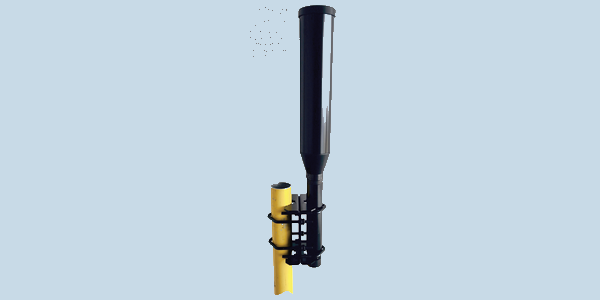
The AD-10/E is a wideband UHF/SHF center-fed dipole antenna operating from 400 to 6000 MHz. Primarily designed for base station applications, it features a radiating element enclosed in a durable composite tube and finished with UV-resistant polyurethane paint.
Technical Summary
- Frequency Range: 400 to 6000 MHz
- Gain: -2 to +4 dBi
- Power Handling: 500 W at 500 MHz, 50 W at 6000 MHz
- Polarization: Vertical
- Design: Center-Fed Dipole
- Connector: N Female
Operational Use Cases
- Secure Communication
- Spectrum Monitoring
- Tactical Communication Base Stations
Deployment Environments
Designed for fixed site base station installations. The exterior is coated in black two-component UV-resistant PU paint to provide long-term environmental protection.
Performance Metrics
- Frequency Coverage: Continuous operation from 400 to 6000 MHz (UHF, L, S, and C bands)
- Gain Performance: -2 to +4 dBi dependent on frequency
- Power Capacity: Scales with frequency, handling up to 500 W at 500 MHz and 50 W at 6000 MHz
Setup & Portability
The antenna includes a 40 mm diameter aluminum attachment pipe. A specialized mounting console adapter is provided, enabling secure installation on masts with diameters up to 60 mm.
Compatibility
Equipped with an N female coaxial connector mounted at the end of the attachment pipe for standard RF cable integration.
FAQs
What is the typical radiation pattern of a vertically polarized dipole?
A dipole generally produces an omnidirectional pattern in the azimuth plane with nulls directed toward the zenith and nadir. Always verify the exact pattern shape using the manufacturer's measured radiation data.
Why does gain vary across wideband antennas?
Wideband omnidirectional antennas inherently experience gain fluctuations across their operating spectrum. Gain may be lower at the bottom of the frequency range for practically sized structures compared to higher frequencies.
Does a center-fed dipole require a ground plane for installation?
Unlike monopole antennas, balanced dipole designs are typically ground-independent and do not rely on a perpendicular ground plane or radials to function correctly.
Problems we solve: how do we narrow antenna choices?
Balancing operating bands, coverage needs and mounting space can make antenna selection difficult. Share those constraints with Cyntony to compare candidate antennas and identify what needs manufacturer confirmation (Our process).
Outcomes we deliver: what changed for Espy's compact monitoring system?
Cyntony helped Espy source antennas that fitted a compact transit case and coordinated later sourcing revisions for removable mounting. This documented result concerns Espy's system; it does not establish this product's dimensions, mounting features or performance (Espy case study).
