


Trival Antene
AD-18/D — Wideband Mobile VHF Antenna
Less than 300 W
Key specifications
- Gain
- Less than 0 dB, 0 to 2 dB
- Power handling
- Less than 300 W
Add this product to your quote to get price and delivery information.
Overview
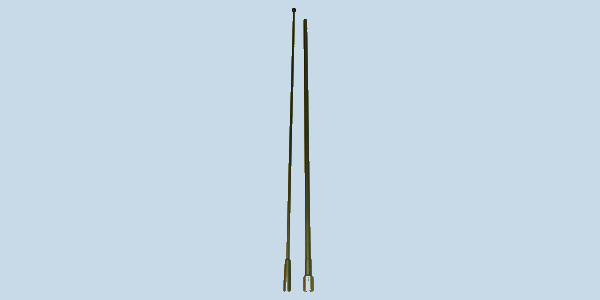
The AD-18/D is a rugged, wideband mobile VHF antenna operating from 30 to 90 MHz, engineered for heavy-duty ground vehicle applications. Built with a shock-absorbing stainless steel spring base and robust composite radiating elements, it reliably supports tactical communications in harsh environments. The antenna features a standard NATO mounting pattern and is available with an optional integrated active GPS L1 antenna for combined communications and positioning functionality.
Technical Summary
- Frequency Range: 30 to 90 MHz (VHF); 1575.42 MHz (GPS L1)
- Maximum Power: 150 W CW
- Gain: -5 to +0.5 dB (relative to a 1/4 wave monopole)
- Polarization: Vertical (VHF); RHCP (GPS)
- Connectors: N female or BNC female
- Base Pattern: 4-hole, 4.5-inch (114.3 mm) NATO standard circle
- Finish: Military green (RAL-6014) UV resistant paint
Operational Use Cases
- Tactical VHF vehicle communications
- Ground vehicle positioning and tracking (with optional GPS module)
- Heavy-duty mobile operations in rough terrain
Deployment Environments
- Heavy-duty ground vehicles
- High shock and vibration environments
- Standard NATO vehicle mounts
- Outdoor deployments requiring UV-resistant military finishes
Performance Metrics
- Power Handling: Rated for up to 150 W CW continuous transmission.
- Gain Performance: Typical VHF gain ranges from -5 to +0.5 dB relative to a 1/4 wave monopole, depending on frequency.
Setup & Portability
The AD-18/D features a modular, three-part construction comprising an antenna base, a lower radiating element, and an upper radiating element. It mounts via four equally spaced holes on a 4.5-inch (114.3 mm) bolt circle, complying with standard NATO vehicular mounting interfaces.
Compatibility
This antenna is compatible with mobile tactical radios operating in the 30-90 MHz band and platforms accepting standard 4.5-inch NATO vehicular mounts. It mates with transmission lines terminated in standard N male or BNC male connectors, depending on the chosen base variant.
FAQs
What determines whether to use a ground-plane dependent monopole or a dipole on a vehicle?
Selection depends on the concept of operations, co-siting requirements with other antennas, and the platform's ability to provide a suitable electrical counterpoise.
How does frequency affect gain in wideband omnidirectional vehicle antennas?
Wideband omnidirectional antennas typically exhibit lower gain at the low end of their frequency range. Always verify continuous performance limits across the target operating band using the datasheet.
How is this antenna mounted to a vehicle?
The base uses a standard four-hole NATO mounting pattern spaced on a 4.5-inch (114.3 mm) circle. Verify that the platform structure supports this bolt pattern and required connector routing.
Problems we solve: how do we narrow antenna choices?
Balancing operating bands, coverage needs and mounting space can make antenna selection difficult. Share those constraints with Cyntony to compare candidate antennas and identify what needs manufacturer confirmation (Our process).
Outcomes we deliver: what did Cyntony's tactical-link field test establish?
Cyntony's 2025 XTND-DIRECT field test showed how terrain, antenna height and clearance affected a specific mesh-radio link. The result informs deployment questions; it does not establish range, throughput or suitability for this product (Field-test account).
