


Trival Antene
AD-27/V190-3108 — Wideband Monopole VHF Low Profile Mobile Antenna
Less than 300 W
Key specifications
- Gain
- Less than 0 dB, 0 to 2 dB, 2 to 4 dB, 16 to 32 dB
- Power handling
- Less than 300 W
Add this product to your quote to get price and delivery information.
Overview
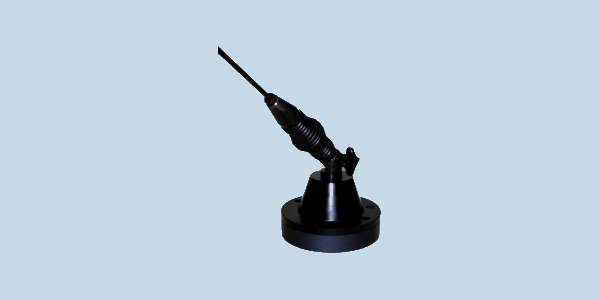
The AD-27/V190-3108 is a wideband monopole VHF low-profile mobile antenna covering the 30 to 108 MHz frequency range. Designed with a conical stainless steel radiator for low visibility and low weight, it is highly versatile and optimized for installation on heavy tracked and lighter wheeled military vehicles.
Technical Summary
- Frequency Range: 30 to 108 MHz (VHF); 1575.42 MHz (Optional L-band GPS)
- Maximum Power: 100 W CW
- Polarization: Vertical (VHF), RHCP (GPS)
- Gain: -9 to +3 dB (VHF); 18 dB (GPS LNA)
- Antenna Type: End-fed whip monopole
- Mounting: NATO AS-1729 (4.5-inch bolt circle)
Operational Use Cases
This antenna supports tactical communication systems requiring continuous VHF coverage in rugged environments. When equipped with the optional integrated GPS antenna, it simultaneously supports critical positioning and navigation requirements for mobile military operations.
Deployment Environments
Engineered for severe environmental conditions, the antenna features a shock-absorbing stainless steel spring that protects against impacts and vibrations commonly encountered during cross-country movement by ground vehicles.
Performance Metrics
The VHF element handles up to 100 W CW and delivers gain ranging from -9 to +3 dB across the 30 to 108 MHz band. The optional integrated GPS LNA provides 18 dB of gain to ensure reliable positioning data.
Setup & Portability
The aluminum and durable plastic base features four mounting holes equally spaced on a 4.5-inch (114.3 mm) circle. An optional tilting mechanism is also available, allowing operators to adjust the inclination radius of the antenna while on the move.
Compatibility
The mounting base conforms to the NATO and US Army AS-1729 standard, ensuring direct compatibility with standard heavy tracked and wheeled military vehicle mounting points.
FAQs
What platform factors influence the choice of a monopole antenna?
Monopole selection depends on the concept of operations and the platform's ability to act as a suitable counterpoise. Vehicles frequently utilize monopoles by leveraging their conductive chassis as a ground plane.
What does a vertical polarization specification indicate?
It signifies that the antenna's emitted electric field is oriented perpendicular to the Earth's surface. Optimal signal transfer occurs when both the transmitting and receiving antennas share this vertical alignment.
What parameters should be verified when matching an antenna to a transmitter?
Ensure the transmitter's frequency range, maximum continuous output power, and tolerable VSWR align with the antenna specifications. Proper impedance matching prevents reflected power from damaging the radio amplifier.
Problems we solve: how do we narrow antenna choices?
Balancing operating bands, coverage needs and mounting space can make antenna selection difficult. Share those constraints with Cyntony to compare candidate antennas and identify what needs manufacturer confirmation (Our process).
Outcomes we deliver: what did Cyntony's tactical-link field test establish?
Cyntony's 2025 XTND-DIRECT field test showed how terrain, antenna height and clearance affected a specific mesh-radio link. The result informs deployment questions; it does not establish range, throughput or suitability for this product (Field-test account).
