


Trival Antene
AD-52 — Wideband Wire Directional Antenna
Less than 300 W
Key specifications
- Frequency band
- VHF
- Gain
- 8 to 16 dB
- Power handling
- Less than 300 W
- Polarization
- Vertical
Add this product to your quote to get price and delivery information.
Overview
The AD-52 from Trival Antene is a wideband wire directional antenna designed for tactical use with handheld and manpack radios. Operating in the 30 to 88 MHz VHF frequency band, it features a specialized wire radiating element with capacitive loadings and a matching transformer to deliver low VSWR and high gain. The antenna is packaged as a complete kit in a transportable linen bag, optimized for quick and easy erection during stationary tactical operations.
Technical Summary
| Frequency Band | 30 to 88 MHz (VHF) |
| Gain | 8 to 16 dB (11.5 dB maximum specified in kit parameters) |
| Power Handling | 100 W CW (rated for less than 300 W total) |
| Polarization | Vertical |
| Antenna Type | Directional Wire |
Operational Use Cases
- Stationary tactical communications ("in stay" operations)
- Range extension for handheld and manpack VHF radios
- Field-expedient directional link establishment
Deployment Environments
This antenna is designed for temporary, stationary field deployments. It is intended for tactical ground environments where an operator can erect a wire structure using the provided anchor, weight, and lifting rope.
Performance Metrics
- Operating Frequency: Continuous wideband coverage from 30 to 88 MHz.
- Gain: Provides 8 to 11.5 dB of directional gain.
- Power Rating: Safely handles 100 W CW transmission power.
- Efficiency: Integrated capacitive loadings and matching transformer minimize VSWR.
Setup & Portability
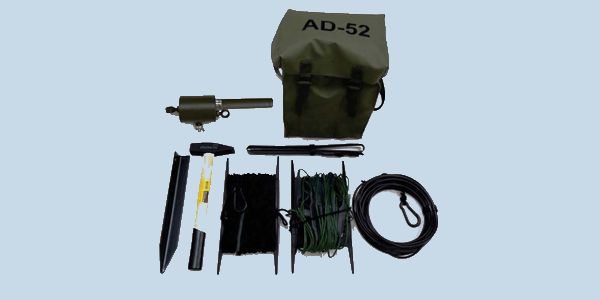
The AD-52 features a simple construction intended for rapid deployment in stationary settings. The complete kit is packed in a transportable linen bag. It includes the wire radiating element, a watertight fiberglass-enclosed matching transformer, a tape radiator serving as a counterpoise, a 15-meter RG-58/U coaxial feeder, a lifting rope, a weight, an anchor, and a hammer.
Compatibility
Compatible with tactical handheld and manpack radios operating within the 30 to 88 MHz VHF band. Connects via the included 15-meter RG-58/U coaxial feeder.
FAQs
What distinguishes a directional antenna from an omnidirectional design?
A directional antenna radiates its energy more effectively in specific directions, typically forming a main lobe and minor lobes. This concentrates radiated power compared to the circular pattern of an omnidirectional antenna.
What does vertical polarization indicate for system compatibility?
Vertical polarization means the electric field of the radiated wave oscillates perpendicular to the ground. For optimal signal transfer, verify that all communicating antennas in the link share this same orientation.
Why is precise installation critical for wire antennas?
The electrical performance of a wire antenna depends on correct element lengths and deployment geometry. Dimensional errors during setup can alter the impedance match and reduce overall radiation efficiency.
Problems we solve: how do we narrow antenna choices?
Balancing operating bands, coverage needs and mounting space can make antenna selection difficult. Share those constraints with Cyntony to compare candidate antennas and identify what needs manufacturer confirmation (Our process).
Outcomes we deliver: what did Cyntony's tactical-link field test establish?
Cyntony's 2025 XTND-DIRECT field test showed how terrain, antenna height and clearance affected a specific mesh-radio link. The result informs deployment questions; it does not establish range, throughput or suitability for this product (Field-test account).
