


Rapid Mobile
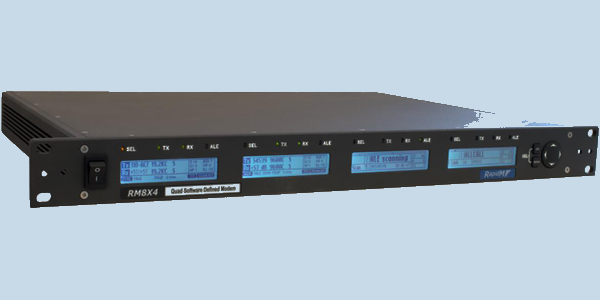
RM8X4 — Quad Software Defined Modem
Key specifications
Add this product to your quote to get price and delivery information.
Overview
The RM8X4 Quad Software Defined Modem is a purpose-built, standalone hardware platform designed for strategic and maritime data communications. It houses four independent modem and ALE controller functions in a compact architecture, providing interoperable link setup and data transfer where size, weight, power, and cost are heavily constrained.
Technical Summary
- Architecture: Quad (4) independent modem and ALE controller functions
- Frequency Bands: LF, MF, HF, VHF, UHF, and wideband V/UHF support
- ALE Integration: Fully integrated 2G and 3G ALE controllers
- Redundancy: Equipped with 4 Power Supply Units (PSUs)
Operational Use Cases
- Strategic and secure data communications
- Naval and maritime shore station operations
- Point-to-point and point-to-multipoint data transfers
- Interoperable link setup operations
Deployment Environments
This modem is suitable for Fixed Site and Maritime environments, specifically supporting both land and ship-borne installations.
Performance Metrics
- Signal Processing: Features 4-channel receive diversity processing to deliver significant performance gains in challenging RF environments.
Setup & Portability
The hardware platform is designed for installation in standard 19-inch equipment racks, occupying only a single 1U slot.
Compatibility
The system offers high commonality with the RM8 platform, utilizing the same wide range of standards-based waveforms and protocols. Specific software-defined functions can be activated via targeted software packs.
FAQs
What primary functions does this modem platform provide?
It serves as a standalone hardware platform housing four independent software-defined modem and automatic link establishment (ALE) controllers. The system supports 2G and 3G ALE protocols alongside four-channel receive diversity for strategic data communications.
Which frequency bands are supported by this equipment?
The platform processes communications across LF, MF, HF, VHF, and UHF bands. Always verify the continuous operating frequency ranges and maximum power tolerances of your specific network hardware against the product datasheet.
How is this equipment installed in operational environments?
The unit mounts into a standard 19-inch equipment rack, occupying a single 1U slot. Confirm structural requirements, grounding, and vibration tolerances for ship-borne or fixed-site deployments prior to installation.
Problems we solve: where do we start with incomplete requirements?
An incomplete specification can make product selection difficult. Start by sharing the task, operating environment and known constraints with Cyntony so the team can help define what to verify and which options are worth discussing (Our process).
Outcomes we deliver: what comes from working through the requirements?
The practical outcome is a requirements-led set of product options to evaluate with Cyntony. Confirm performance, compatibility and any service scope for your configuration before selection (Our process).
