


Trival Antene
AD-18/E — Wideband Dipole Mobile Antenna
Less than 300 W
Key specifications
- Gain
- Less than 0 dB, 0 to 2 dB
- Power handling
- Less than 300 W
Add this product to your quote to get price and delivery information.
Overview
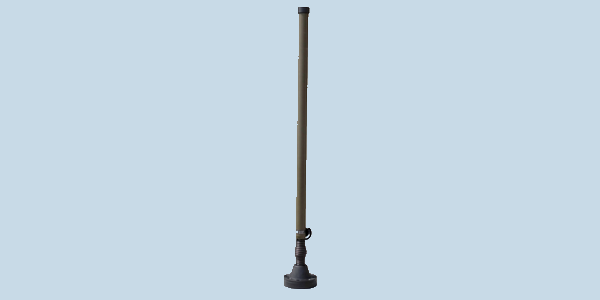
The AD-18/E is a heavy-duty, wideband dipole mobile antenna designed for ground vehicle applications in the 225 to 512 MHz UHF frequency range. It features an electrically independent center-fed whip design and offers an optional built-in active GPS L1 patch antenna for positioning and tactical communication.
Technical Summary
- Frequency Range: 225 to 512 MHz (UHF); 1575.42 MHz (L-Band GPS optional)
- Gain: -1 to +2 dBi
- Power Handling: 100 W CW maximum
- Polarization: Vertical (UHF); RHCP (GPS)
- Design: Center-fed whip
Operational Use Cases
- Tactical Communication: Provides reliable wideband UHF coverage for mobile transceivers in harsh environments.
- Vehicle Positioning: The optional built-in GPS L1 active antenna with LNA supports location tracking and navigation for heavy-duty platforms.
Deployment Environments
Engineered for heavy-duty ground vehicles, the antenna is housed in an extremely durable 43 mm diameter fiberglass whip made with composite materials. The base incorporates a biconical stainless steel spring to absorb severe shocks and vibrations, and the entire assembly is finished in a military green (RAL-6014) two-component UV-resistant paint.
Performance Metrics
The AD-18/E operates continuously at up to 100 W CW and delivers an omnidirectional gain of -1 to +2 dBi across the UHF band. Its center-fed dipole construction ensures that the electrical performance remains completely independent of the ground plane or mounting location.
Setup & Portability
The antenna system consists of two main parts—the radiator and the antenna base—simplifying handling and maintenance. It installs directly onto vehicles using a standard NATO 4.5-inch (114.3 mm) four-hole mounting circle.
Compatibility
The base is mechanically compatible with platforms utilizing a standard NATO 4.5-inch four-hole mounting interface. The optional GPS feature requires a receiver compatible with active L1 patch antennas.
FAQs
What is the advantage of a ground-plane independent center-fed whip?
It maintains consistent electrical characteristics and tuning regardless of the mounting surface. This simplifies installation on various vehicles and structures without requiring a specific conductive surface area.
How do power levels and impedance affect transmit applications?
Matching the antenna to the continuous output power and maximum tolerable VSWR of the transmitter prevents amplifier damage. Always verify the transmitter's requirements against the antenna's continuous wave rating.
How is this antenna secured to a platform?
The base incorporates a standard NATO 4.5-inch four-hole mounting pattern. Confirm that the intended vehicle platform or bracket matches this specific bolt circle arrangement prior to integration.
Problems we solve: how do we narrow antenna choices?
Balancing operating bands, coverage needs and mounting space can make antenna selection difficult. Share those constraints with Cyntony to compare candidate antennas and identify what needs manufacturer confirmation (Our process).
Outcomes we deliver: what did Cyntony's tactical-link field test establish?
Cyntony's 2025 XTND-DIRECT field test showed how terrain, antenna height and clearance affected a specific mesh-radio link. The result informs deployment questions; it does not establish range, throughput or suitability for this product (Field-test account).
