


Trival Antene
AD-21/3512 — Wideband Monopole Mobile Antenna
Less than 100 W
Key specifications
- Gain
- Less than 0 dB
- Power handling
- Less than 100 W
- Polarization
- Vertical
Add this product to your quote to get price and delivery information.
Overview
The AD-21/3512 is a wideband low-profile monopole mobile antenna designed for tactical communications. Operating continuously across the 30 to 512 MHz frequency range, it provides versatile deployment options. The radiator can attach directly to portable handheld radios or integrate into a mobile ground vehicle configuration.
Technical Summary
- Frequency Range: 30 to 512 MHz (VHF and UHF)
- Power Handling: 50 W CW
- Polarization: Vertical
- Gain: Less than 0 dB (-20 to -2 dBi)
- Radiator Construction: Flexible stainless steel whip with shock-absorbing spring
- Radiator Interface: N male coaxial connector
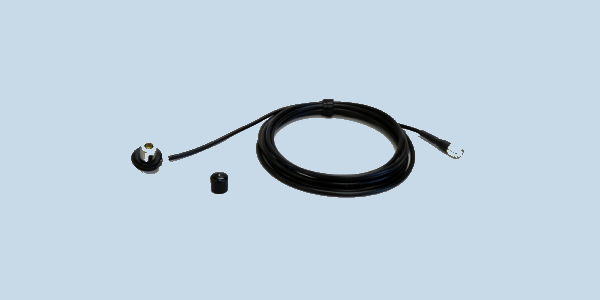
- Mobile Base Cable: 4-meter integrated coaxial cable with FME female connector
- Finish: UV-protective black polyurethane paint
Operational Use Cases
This antenna supports tactical communication applications across VHF and UHF bands. Its compact, low-profile design ensures survival in dynamic field conditions, making it suitable for both multi-band handheld transceiver operations and mobile ground vehicle networks.
Deployment Environments
Constructed for demanding outdoor field conditions, the antenna features a durable stainless steel whip and a UV-protective polyurethane coating. An integrated shock-absorbing spring at the base protects the radiator against physical impacts during movement.
Performance Metrics
The AD-21/3512 handles up to 50 W CW power for moderate-power tactical transceivers. Operating as a wideband monopole, it delivers a continuous frequency response with a specified gain range of -20 to -2 dBi.
Setup & Portability
The antenna radiator utilizes an N male connector and a matching transformer unit for direct, independent attachment to compatible portable radios. Mobile ground vehicle deployments are supported by pairing the radiator with either the ADM-21/N magnetic base or the ADN-21/N fixed base.
Compatibility
Designed for interoperability with portable and mobile tactical radios in the 30 to 512 MHz band. Operators should verify that the transceiver interface accepts the N male connector on the radiator or the FME female connector provided on the mobile base cables.
FAQs
What platform factors influence the choice of a monopole antenna?
Monopoles are typically selected for handhelds or vehicles where the radio chassis or metal mounting surface can serve as a counterpoise. Verify that the installation location provides a suitable ground plane.
Why do wideband omnidirectional antennas exhibit negative gain at lower frequencies?
To maintain a physically manageable size for tactical operations, broadband structures inherently trade efficiency for bandwidth. This typically results in negative gain values at the lowest operating frequencies.
How does vertical polarization affect deployment?
It produces an electric field oriented perpendicular to the earth. To ensure maximum signal transfer, verify that the transmitting and receiving antennas share the same polarization orientation during installation.
Problems we solve: how do we narrow antenna choices?
Balancing operating bands, coverage needs and mounting space can make antenna selection difficult. Share those constraints with Cyntony to compare candidate antennas and identify what needs manufacturer confirmation (Our process).
Outcomes we deliver: what did Cyntony's tactical-link field test establish?
Cyntony's 2025 XTND-DIRECT field test showed how terrain, antenna height and clearance affected a specific mesh-radio link. The result informs deployment questions; it does not establish range, throughput or suitability for this product (Field-test account).
