


Trival Antene
AD-22/A — Log-Periodic Dipole Antenna (100-512 MHz)
Less than 1 kW
Key specifications
- Gain
- 4 to 8 dB
- Power handling
- Less than 1 kW
- Polarization
- Vertical, Horizontal
Add this product to your quote to get price and delivery information.
Overview
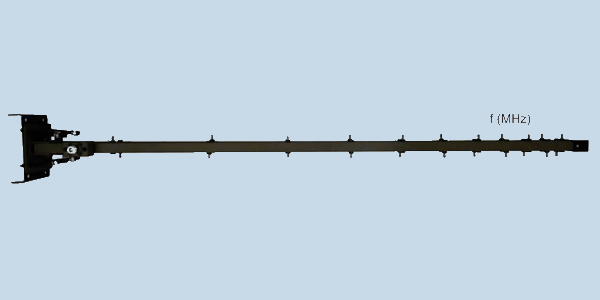
The AD-22/A is a directional log-periodic dipole antenna engineered for the 100 to 512 MHz frequency range. Built with aluminum alloy elements and a central boom, it is designed primarily for stationary applications requiring durable, wideband V/UHF performance.
Technical Summary
- Frequency Range: 100 - 512 MHz
- Gain: 6 - 7 dBi
- Impedance: 50 ohms
- VSWR: Typically < 1.5
- Maximum Power: 500 W CW
- Polarization: Horizontal and Vertical
- Connector: N female
- Mass: 4 kg
Operational Use Cases
This wideband antenna is suitable for stationary RF applications, including:
- Spectrum monitoring
- Secure communications
- Tactical network extension
Deployment Environments
Optimized for fixed-site and stationary deployments. The antenna features aluminum alloy elements, stainless steel joints, and UV-resistant polyurethane paint to ensure long-term survivability in demanding outdoor environments.
Performance Metrics
- Power Handling: Rated for high-power continuous wave transmission up to 500 W CW.
- Efficiency: Maintains a typical VSWR of under 1.5 across the band.
- Directional Gain: Consistently provides 6 to 7 dBi across the 100 to 512 MHz spectrum.
Setup & Portability
The antenna includes a specialized support mounted on the boom, facilitating rapid switching between horizontal and vertical polarization. The 11 dipoles attach to the boom using secure screw joints. The complete assembly weighs 4 kg and attaches easily to standard mast infrastructure.
Compatibility
- Mast Mounting: Compatible with mast outer diameters ranging from 20 to 60 mm.
- RF Interface: Accepts standard N male connectors via the integrated N female port.
FAQs
What is the benefit of a directional antenna for tactical communications?
Directional antennas concentrate radiated power in a specific direction rather than broadcasting equally in all azimuths. This increases signal strength toward the intended target while reducing unintended emissions, complicating detection and jamming efforts by adversarial forces.
Why is matching antenna polarization important?
Antennas achieve the most efficient transmission and reception path when their polarizations align. A linearly polarized antenna oriented vertically communicates best with a receiving antenna that is similarly configured to capture vertical electromagnetic waves.
How does a log-periodic dipole array (LPDA) achieve directionality?
An LPDA produces a directional beam by combining radiation from appropriately sized dipole elements spaced along a central boom. Verify the specific radiation pattern and front-to-back ratio for the operating frequency on the manufacturer's datasheet.
Problems we solve: how do we narrow antenna choices?
Balancing operating bands, coverage needs and mounting space can make antenna selection difficult. Share those constraints with Cyntony to compare candidate antennas and identify what needs manufacturer confirmation (Our process).
Outcomes we deliver: what did Cyntony's tactical-link field test establish?
Cyntony's 2025 XTND-DIRECT field test showed how terrain, antenna height and clearance affected a specific mesh-radio link. The result informs deployment questions; it does not establish range, throughput or suitability for this product (Field-test account).
