Download our Antenna Buyer’s Guide Today

Download our Antenna Buyer's Guide to discover the essential specs and features to look out for while finding the perfect antenna for your project.

Search with confidence and efficiency.

tab-img

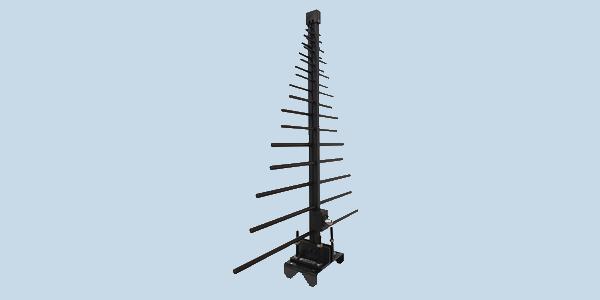
AD-22/P — Wideband Log-Periodic Dipole Antenna (300-7000 MHz)

Interested in learning more about this product?

Overview

The AD-22/P is a wideband log-periodic dipole antenna manufactured by Trival Antene, providing continuous frequency coverage from 300 to 7000 MHz. It features a robust aluminum and stainless steel construction designed for high-power broadcast, EMC applications, radio monitoring, and jamming operations.

Technical Summary

  • Frequency Range: 300 - 7000 MHz (UHF, L, S, C bands)
  • Gain: 7 dBi typical (4 to 8 dB)
  • Power Handling: 150 W CW maximum
  • Polarization: Horizontal and Vertical
  • Connector: N female
  • Construction: Aluminum alloy dipoles, stainless steel boom and joints

Operational Use Cases

  • Radio monitoring and spectrum analysis
  • Electromagnetic compatibility (EMC) testing
  • Tactical and fixed-site jamming
  • Wideband broadcasting

Deployment Environments

Suitable for fixed site and tactical platforms. All metal components are coated with UV-resistant polyurethane paint for durability during sustained outdoor deployment.

Performance Metrics

  • Frequency Coverage: 300 to 7000 MHz
  • Typical Gain: 7 dBi
  • Power Rating: Up to 150 W CW

Setup & Portability

The antenna includes a specialized support mounted on the boom element to facilitate rapid switching between horizontal and vertical polarization. It accommodates installation on masts with outer diameters ranging from 20 to 60 mm. The 24 dipole elements attach to the boom via simple screw joints.

Compatibility

  • RF Interface: N female connector
  • Mounting Interface: Compatible with 20 to 60 mm outer diameter masts

FAQs

  • How does a log-periodic dipole array achieve directional coverage? Log-periodic antennas produce directional beams using appropriately sized dipole elements spaced along a central boom. This configuration focuses radiated power in a specific direction while significantly diminishing signals from the rear.
  • Why is matching antenna polarization important? An antenna generates an electromagnetic wave oriented in a specific plane. Matching the linear polarization state between transmitting and receiving antennas provides the most efficient transmission path and minimizes signal loss.
  • What are the benefits of mounting directional antennas on a telescoping mast? Raising an antenna on a mast improves line-of-sight propagation over obstacles and extends standoff range. This positioning enhances signal reach while allowing associated equipment and personnel to remain concealed.
  • Problems we solve: how do we narrow antenna choices? Balancing operating bands, coverage needs and mounting space can make antenna selection difficult. Share those constraints with Cyntony to compare candidate antennas and identify what needs manufacturer confirmation (Our process).
  • Outcomes we deliver: what comes from working through the requirements? The practical outcome is a requirements-led set of product options to evaluate with Cyntony. Confirm performance, compatibility and any service scope for your configuration before selection (Our process).

Video Notes

Demonstrate the integrated support bracket transitioning the antenna between horizontal and vertical polarization. Show the screw-joint assembly of the dipoles and mounting onto a standard 40mm mast.

HOW TO BUY
To obtain price and delivery information about this product, click the button below.