

.svg)


Want to get tariffs back?
The Tariff Act of 1930 codified duty drawback (in 19 U.S.C. 1313) for the modern era in an overly bureaucratic way, then the Trade Facilitation and Trade Enforcement Act (TFTEA) of 2015 modernized and streamlined the process of seeking and gaining duty drawback for the digital age; such that the government will give you back 99% of the duties paid on the original imported material. This video will give a quick introduction, without voiceover, so feel free to mute the music.
Actually accomplishing duty drawback requires some wherewithal and cooperation for our typical scenario of Cyntony being the importer and your company being the exporter, but it is possible to gain the refund with the help of a specialist licensed customs broker and agreement among the parties to split the refund fairly.
How duty drawback works with Cyntony
Many products that Cyntony sells are imported and subject to tariffs. Cyntony becomes the importer of record and we pay duty, tariff and fees. Generally these costs are built into the price of our goods.
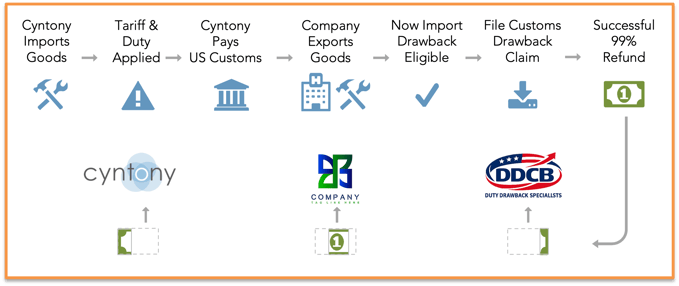
The general process would go something like the diagram above. Cyntony sources the goods, imports and pays duty and/or tariff. Your company incorporates the goods into your product and exports. Transaction records of exports that are potentially eligible for duty drawback would be identified and provided to duty drawback customs broker (DDCB) by your company, and corresponding import records would be provided by Cyntony to the DDCB. They then apply for the necessary license/account from US Customs. Applications for drawback would be made by the broker, handling all the details and back and forth with US Customs. Refund of duty/tariff would go to the DDCB to be distributed to your company and Cyntony per prior agreed proportions.
Check with your expert
We present this information in the spirit of helpfulness and collaboration, it is certainly not legal or operational advice. Please consult your export and import staff or consultant as the expert on your situation.
We're here to help
Cyntony will facilitate and coordinate with you to make sure tariff related documentation and bureaucratic details are handled adroitly. We invite you to contact us with any questions or concerns, as we fulfill our pledge to provide customer-attuned collaboration to assure successful outcomes for you and your customers.
