


Trival Antene
AD-40/722-14 — UHF Directional Yagi Antenna
Less than 300 W
Key specifications
- Frequency band
- UHF
- Gain
- 8 to 16 dB
- Power handling
- Less than 300 W
- Polarization
- Vertical, Horizontal
Add this product to your quote to get price and delivery information.
Overview
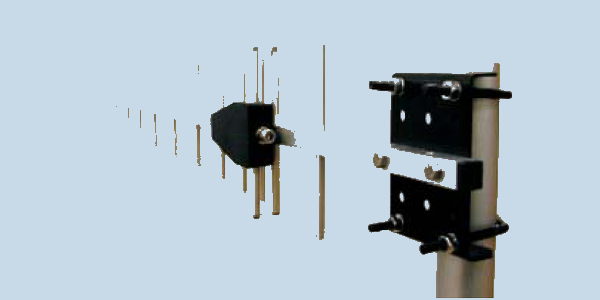
The AD-40/722-14 is a 14-element directional Yagi antenna designed for the 698 to 746 MHz UHF frequency range. Constructed from anodized aluminum and stainless steel, it delivers reliable high-gain performance for data links, monitoring, and tactical communication networks.
Technical Summary
- Frequency Range: 698 to 746 MHz (UHF)
- Antenna Type: 14-Element Directional Yagi
- Gain: 13 dBd
- Polarization: Vertical or Horizontal
- Power Handling: Maximum 100 W
- Protection: DC Grounded
Operational Use Cases
- Tactical Communication: Provides focused directional coverage for reliable point-to-point links.
- Data Links: Concentrates RF energy to maintain stable, high-gain connections.
- Monitoring: Facilitates targeted signal reception within the 698 to 746 MHz band.
Deployment Environments
This antenna is engineered for fixed site installations in harsh climatic conditions. All metal parts are DC grounded for lightning protection, and the matching unit is housed in a protective plastic casing to ensure consistent operation.
Performance Metrics
The AD-40/722-14 delivers 13 dBd gain. Its folded dipole radiator is designed to maintain constant characteristics across the entire operating frequency band.
Setup & Portability
A rear-mounted stainless steel adapter allows the antenna to be configured for either vertical or horizontal polarization. Verify the exact pipe mounting diameter limits with the manufacturer before fixed site installation.
Compatibility
This antenna is compatible with UHF systems operating between 698 and 746 MHz with output power up to 100 W. The selected polarization must be aligned with the mating antenna in the link for optimal signal transfer.
FAQs
What is the primary advantage of a directional antenna?
A directional antenna radiates energy more effectively in a specific direction, increasing gain in the favored path. This concentrates the signal and helps reduce unintended detection from other directions.
What does the front-to-back ratio indicate for directional antennas?
The front-to-back ratio compares the peak forward gain to the gain 180 degrees behind it. This metric determines how well the antenna rejects signals arriving from the rear.
What is AD-40/722-14 — UHF Directional Yagi Antenna used for?
AD-40/722-14 — UHF Directional Yagi Antenna is categorized as Directional Antenna. Listed applications include Data Links, Monitoring, Tactical Communication.
Problems we solve: how do we narrow antenna choices?
Balancing operating bands, coverage needs and mounting space can make antenna selection difficult. Share those constraints with Cyntony to compare candidate antennas and identify what needs manufacturer confirmation (Our process).
Outcomes we deliver: what did Cyntony's tactical-link field test establish?
Cyntony's 2025 XTND-DIRECT field test showed how terrain, antenna height and clearance affected a specific mesh-radio link. The result informs deployment questions; it does not establish range, throughput or suitability for this product (Field-test account).
