


Walking Down RF Interference
Portable spectrum-analysis equipment allows you to investigate interference directly in the environment where the problem occurs. Paired up with an appropriate directional antenna, the same equipment can help turn interference detection into signal hunting.
Step 1: Identify the Signal
A portable analyzer like the Spectrum Compact can help determine whether unexpected RF energy is present and examine signal level and frequency.
Measurement can also help distinguish an RF interference problem from other system issues.
Step 2: Establish a Baseline
Once the signal of interest has been identified, establish its approximate level at the starting location.
This provides a reference as the operator moves through the environment.
Depending on the application, measurements may also be saved for later analysis, comparison, or reporting.
Step 3: Add Directionality
A spectrum analyzer tells you that a signal is present.
A directional antenna can provide the next piece of information: where the signal appears strongest.
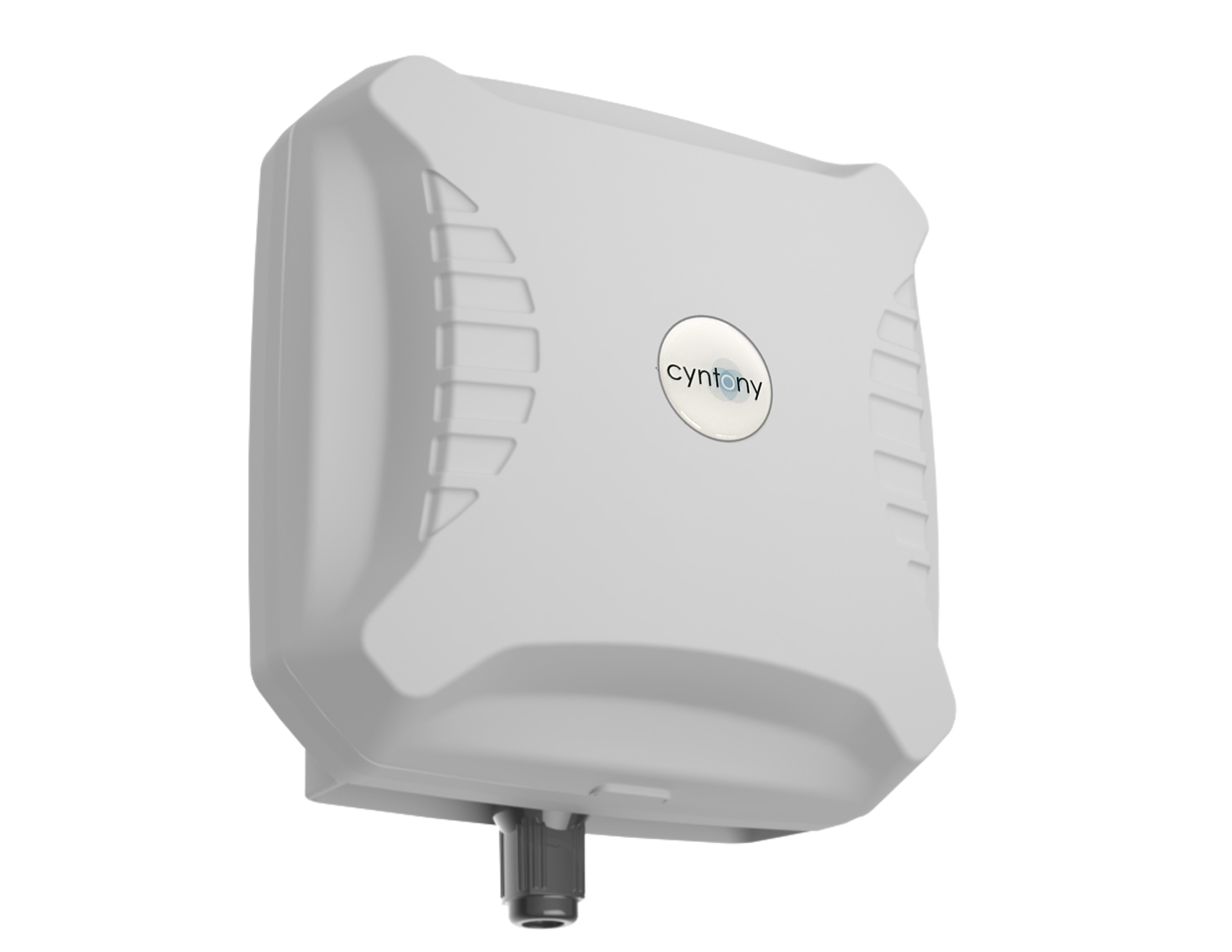
Cyntony's VHF/UHF Signal Hunting & Direction Finding Kit pairs a Spectrum Compact analyzer with a wideband LPDA directional antenna on a pistol-grip handle.
You can point the antenna in different directions, observe the received signal level, and identify the direction associated with the greatest amplitude.
Step 4: Walk Down the Signal
Once a probable direction has been established, you can move toward the suspected source and repeat the measurement.
Point.
Measure.
Move.
Repeat.
As the operator approaches the source, changes in received signal strength can help narrow the search area.
A Field-Ready Signal Hunting Kit
Cyntony's VHF/UHF Signal Hunting & Direction Finding Kit combines:
- SAF Tehnika Spectrum Compact 10 MHz–3 GHz analyzer
- Wideband 650–3,000 MHz LPDA antenna
- Pistol-grip handle and mounting bracket
- RF jumper cables and adapters
- Charging equipment
- Carrying bag and lanyard
The analyzer provides RSSI directly on its touchscreen, allowing one operator to scan, identify, and walk down a signal without a laptop.
Where Can Signal Hunting Be Used?
Potential applications include:
- RF interference hunting
- Signal verification
- Public safety RF monitoring
- Utility communications troubleshooting
- Unauthorized-emitter investigation
- Communications troubleshooting
- Site surveys
SAF's broader Spectrum Compact platform also supports applications across frequency regulation, satellite communications, smart-grid connectivity, broadcast operations, and other environments where unexpected RF activity can affect system performance.
Choosing the Right Antenna
Different signal-hunting applications may require different antennas. Important considerations include:
- Frequency range
- Antenna gain
- Directionality
- Polarization
- Port compatibility
- Portability
- Deployment environment
Cyntony's broader antenna portfolio includes log-periodic, monitoring, omnidirectional, and direction-finding antennas covering a wide variety of frequency ranges and deployment requirements.
Explore Monitoring & DF Antennas
Frequently Asked Questions
What equipment do I need to find RF interference?
A typical field configuration includes a spectrum analyzer covering the frequencies of interest and an appropriate antenna. A directional antenna can be especially useful when the objective is to locate the source rather than simply detect the interference.
How does a directional antenna help locate interference?
Directional antennas receive signals more strongly from certain directions. By comparing signal level while changing antenna orientation and position, an operator can progressively narrow the likely direction and location of a signal source.
Do I need a laptop to use Spectrum Compact for signal hunting?
Not for the basic workflow used by Cyntony's VHF/UHF Signal Hunting Kit. Signal level can be observed directly on Spectrum Compact's touchscreen.
Can Spectrum Compact save measurements?
Yes. Spectrum Compact supports saving measurement data, and SAF's Spectrum Manager software provides additional capabilities for reviewing and analyzing measurements.
Can Cyntony build a kit for a different frequency range?
Cyntony can help evaluate analyzers, antennas, cables, adapters, and accessories for different frequency ranges and field requirements.
Trying to Find an RF Problem?
Let us know:
What frequency are you working with?
What are you seeing?
Where is it happening?
What are you trying to locate?
Cyntony can help identify the equipment and configuration appropriate for the job.