Download our Antenna Buyer’s Guide Today

Download our Antenna Buyer's Guide to discover the essential specs and features to look out for while finding the perfect antenna for your project.

Search with confidence and efficiency.

tab-img

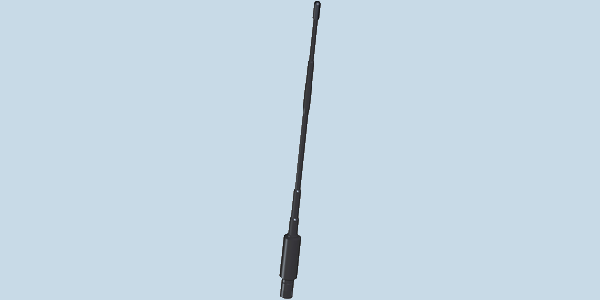
AD-65/B-1512 — Wideband Low-Profile Monopole Antenna

Interested in learning more about this product?

Overview

The AD-65/B-1512 is a wideband low-profile monopole antenna engineered for portable and manpack radios, as well as other RF devices. Covering the 100 to 520 MHz frequency range, it integrates a reactively loaded flexible radiator designed to provide a flat gain curve across the UHF band.

Technical Summary

  • Antenna Type: Wideband Low-Profile Monopole
  • Frequency Range: 100 to 520 MHz (VHF/UHF)
  • Polarization: Vertical
  • Power Handling: Up to 20 W CW
  • RF Connector: N male
  • Finish: UV-resistant polyurethane black paint

Operational Use Cases

Optimized for tactical field communications, this antenna is intended for use with portable and manpack radios operating in the VHF and UHF bands. It provides a rugged, flexible radiating element suitable for operations requiring up to 20 W CW continuous power.

Deployment Environments

Designed for demanding outdoor conditions, the antenna utilizes varied materials for optimal flexibility and roughness. The transformer matching unit is shielded against environmental exposure with UV-resistant polyurethane black paint.

Performance Metrics

  • Operating Frequencies: 100 to 520 MHz
  • Maximum Input Power: 20 W CW
  • Polarization: Vertical
  • Gain Characteristics: Flat gain curve across the UHF frequency range via reactive loading

Setup & Portability

The unit is composed of a flexible radiator and a compact transformer unit. It connects directly to radio equipment via a standard N male connector, facilitating rapid deployment on portable and manpack platforms.

Compatibility

Compatible with manpack radios, portable transceivers, and other RF devices operating within the 100 to 520 MHz range that support an N-type female interface and output 20 W CW or less.

FAQs

  • When is a monopole antenna typically used instead of a dipole? Monopoles are generally selected for handheld and manpack radios, while fixed-site and portable applications often use dipoles. The optimal choice depends on the specific platform and its ability to form a suitable ground plane counterpoise.
  • What power specifications must be verified for transmit applications? Verify that the maximum continuous output power of the connected transmitter does not exceed the antenna's rated continuous wave (CW) power limit to ensure survival and prevent damage.
  • How is the radiation pattern of an omnidirectional antenna verified? The three-dimensional radiation properties are typically described using principal plane cuts along the elevation and azimuth axes. Verify the manufacturer's measured elevation and azimuth patterns to confirm the power covers the intended operational area.
  • Problems we solve: how do we narrow antenna choices? Balancing operating bands, coverage needs and mounting space can make antenna selection difficult. Share those constraints with Cyntony to compare candidate antennas and identify what needs manufacturer confirmation (Our process).
  • Outcomes we deliver: what comes from working through the requirements? The practical outcome is a requirements-led set of product options to evaluate with Cyntony. Confirm performance, compatibility and any service scope for your configuration before selection (Our process).

Video Notes

A brief demonstration showing the flexibility of the radiator and the attachment of the N male connector to a typical manpack radio would help illustrate the physical scale and ruggedness of the unit.

HOW TO BUY
To obtain price and delivery information about this product, click the button below.