Download our Antenna Buyer’s Guide Today

Download our Antenna Buyer's Guide to discover the essential specs and features to look out for while finding the perfect antenna for your project.

Search with confidence and efficiency.

tab-img

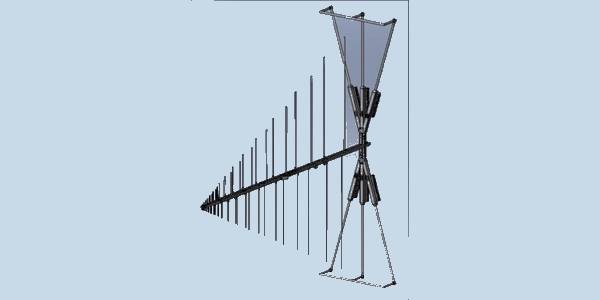
LPDA-A0036 — Wideband LPDA Antenna

Interested in learning more about this product?

Overview

The LPDA-A0036 is a directional log-periodic dipole array that provides continuous coverage across the 20 to 3000 MHz frequency band. It supports HF, VHF, and UHF operations and is built for wideband monitoring and high-power applications. The antenna features a rugged IP56-rated construction designed for straightforward assembly and disassembly.

Technical Summary

  • Frequency Range: 20 to 3000 MHz (HF, VHF, UHF)
  • Gain: 6 dBi typical over 90% of the band
  • Power Handling: Up to 2000 W (model dependent)
  • Polarization: Adjustable (Vertical and Horizontal)
  • Environmental Rating: IP56
  • Mounting Interface: Swivel mounting bracket

Operational Use Cases

  • Wideband spectrum monitoring
  • High-power RF transmission applications

Deployment Environments

This antenna features an IP56-rated rugged construction, making it suitable for demanding outdoor environments where protection against dust and high-pressure water jets is required.

Performance Metrics

The system exhibits a typical gain of 6 dBi over 90% of its operating band while maintaining a low VSWR. High-power versions are capable of handling up to 2000 W of RF power.

Setup & Portability

The antenna is designed to be easy to assemble and disassemble. It includes a swivel mounting bracket that allows operators to manually adjust the polarization between vertical and horizontal orientations.

FAQs

  • What is a directional log-periodic dipole array (LPDA)? An LPDA produces a directional beam using appropriately sized dipole elements spaced along a boom. This design delivers higher radiated power in a favored direction compared to an omnidirectional antenna.
  • How does antenna gain relate to the radiation pattern? Higher gain indicates that the radiated energy is concentrated over a narrower beamwidth. Engineers use azimuth and elevation radiation patterns to visualize this focus and select antennas for specific line-of-sight applications.
  • Why is adjustable polarization important for RF links? Polarization describes the orientation of the transmitted electric field. Antennas with matching polarization orientations provide the best transmission and reception path, minimizing signal loss between the communicating nodes.
  • Problems we solve: how do we narrow antenna choices? Balancing operating bands, coverage needs and mounting space can make antenna selection difficult. Share those constraints with Cyntony to compare candidate antennas and identify what needs manufacturer confirmation (Our process).
  • Outcomes we deliver: what comes from working through the requirements? The practical outcome is a requirements-led set of product options to evaluate with Cyntony. Confirm performance, compatibility and any service scope for your configuration before selection (Our process).

Video Notes

A brief demonstration showing the assembly process and how the swivel bracket adjusts the polarization would be useful.

HOW TO BUY
To obtain price and delivery information about this product, click the button below.