Download our Antenna Buyer’s Guide Today

Download our Antenna Buyer's Guide to discover the essential specs and features to look out for while finding the perfect antenna for your project.

Search with confidence and efficiency.

tab-img

LPDA-A0067 — High-Power LPDA Antenna

Interested in learning more about this product?

Overview

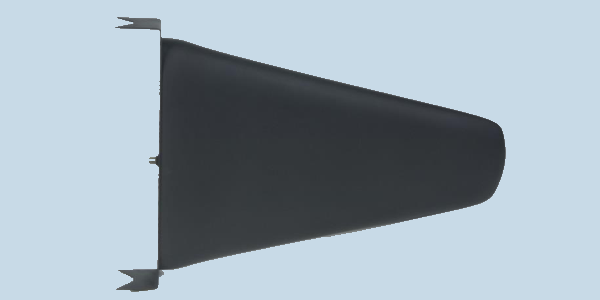
The LPDA-A0067 is a directional log-periodic dipole array designed for high-power applications across the 800 to 3000 MHz frequency band. By integrating two high-gain log-periodic antennas connected in phase within a common radome, it delivers an impressive 12 dBi average gain while maintaining a relatively small form factor.

Technical Summary

  • Frequency Range: 800 to 3000 MHz (UHF)
  • Average Gain: 12 dBi
  • Power Handling: 200W (LPDA-A0067) or 400W (LPDA-A0067-01)
  • Environmental Rating: IP65 (water and dust resistant)
  • Antenna Type: Directional Log-Periodic Dipole Array

Operational Use Cases

This antenna is engineered for high-power transmission and reception tasks that require focused directional coverage over a wide UHF frequency range. It is well-suited for fixed-site communications, signal monitoring, and applications requiring high gain in a compact footprint.

Deployment Environments

Constructed with a rugged, IP65-rated design, this antenna is built to withstand water and dust ingress. This ensures reliable operation in harsh environmental conditions, making it highly suitable for permanent outdoor fixed-site installations.

Performance Metrics

  • Gain: 12 dBi average across the operating band
  • Frequency Coverage: 800 to 3000 MHz
  • Power Capacity: 200W standard, up to 400W in the high-power variant

Setup & Portability

The antenna is supplied with dedicated mounting hardware designed for a 60 mm mast, facilitating straightforward installation at fixed sites.

FAQs

  • What is a directional antenna? A directional antenna radiates and receives energy more effectively in specific directions compared to others. This focuses the signal into a main lobe, which isolates intended signals and reduces interference from unwanted directions.
  • How does higher antenna gain affect the radiation pattern? Higher gain generally indicates that radiation is concentrated over a smaller beamwidth. This provides greater range in a focused direction, which is ideal for line-of-sight applications but requires precise physical alignment.
  • How are radiation patterns used during installation? Principal plane patterns for azimuth and elevation show how an antenna radiates in three-dimensional space. Verify the manufacturer's specific pattern graphs to ensure the antenna's main beam aligns properly with the required coverage area.
  • Problems we solve: how do we narrow antenna choices? Balancing operating bands, coverage needs and mounting space can make antenna selection difficult. Share those constraints with Cyntony to compare candidate antennas and identify what needs manufacturer confirmation (Our process).
  • Outcomes we deliver: what comes from working through the requirements? The practical outcome is a requirements-led set of product options to evaluate with Cyntony. Confirm performance, compatibility and any service scope for your configuration before selection (Our process).

Video Notes

Note: A video illustrating the internal dual-LPDA phase configuration or demonstrating the mast-mounting hardware would be useful for prospective buyers.

HOW TO BUY
To obtain price and delivery information about this product, click the button below.