


Rapid Mobile
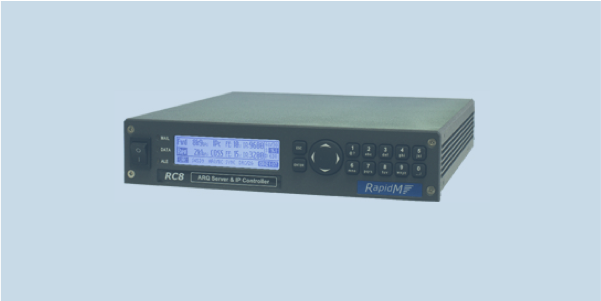
RC8 — ARQ Server & IP Controller
Key specifications
- Frequency band
- HF
Add this product to your quote to get price and delivery information.
Overview
The Rapid Mobile RC8 is a purpose-built ARQ Server and IP Controller designed for maritime and strategic beyond line-of-sight (BLOS) high-frequency (HF) communications. When deployed with the RM8 Software Defined Modem and an external bulk encryptor, it delivers secure data and position communication capabilities across degraded HF channels. The platform features an embedded STANAG 5066 (Edition 3) ARQ server and a STANAG 4538 Proxy for reliable tactical networking.
Technical Summary
Engineered for secure HF communications, the RC8 provides comprehensive control and interface functions. Key technical capabilities include:
- Embedded STANAG 5066 ARQ Server (JITC certified)
- Embedded STANAG 4538 Proxy
- Embedded IP and COSS Clients
- Bypass Mode for legacy ACP-127/COSS operations
- Multiplexing for concurrent application access
- Synchronous balanced DCE port for COMSEC bulk encryption integration
Operational Use Cases
The RC8 supports secure and tactical communications for fixed-site, maritime, and airborne applications. It enables error-free data transfer and legacy network bridging (ACP-127) for strategic BLOS links, ensuring continuous mission connectivity over HF networks.
Deployment Environments
Designed for maritime shore, ship-borne, and airborne installations, the RC8 features a compact form factor optimized for standard 19-inch rack integration. It operates on a wide-range AC power supply suitable for diverse platform and base station environments.
Setup & Portability
The unit requires standard 19-inch rack mounting. It features built-in serial and Ethernet interfaces to connect directly with data terminals, external GPS devices, and COMSEC units.
Compatibility
The RC8 is compatible with the RM8 Software Defined Modem and ALE. It interfaces seamlessly with external bulk/serial encryptors via a synchronous balanced DCE port and supports concurrent radio line access through its multiplexed data ports.
FAQs
Why use an IP controller for high-frequency tactical communications?
Integrating Internet Protocol (IP) and packet switching with radio channels allows traditional RF networks to support modern data services. This bridges tactical radio links with wide-area networks for reliable beyond line-of-sight data transfer.
How is COMSEC implemented in tactical radio data networks?
Secure data networks require dedicated encryption devices to encrypt transmissions and decrypt received signals. Integrating these external COMSEC modules requires proper hardware interfaces and adherence to remote keying procedures.
What should be verified before installing rack-mounted communications controllers?
Confirm that the platform's alternating current (AC) power supply meets the controller's input requirements. Ensure the 19-inch rack enclosure provides sufficient clearance for routing the required serial, Ethernet, and synchronous balanced DCE cables.
Problems we solve: where do we start with incomplete requirements?
An incomplete specification can make product selection difficult. Start by sharing the task, operating environment and known constraints with Cyntony so the team can help define what to verify and which options are worth discussing (Our process).
Outcomes we deliver: what comes from working through the requirements?
The practical outcome is a requirements-led set of product options to evaluate with Cyntony. Confirm performance, compatibility and any service scope for your configuration before selection (Our process).
