RM34 — Ultra-Wideband V/UHF Software Defined Modem
Interested in learning more about this product?
Overview
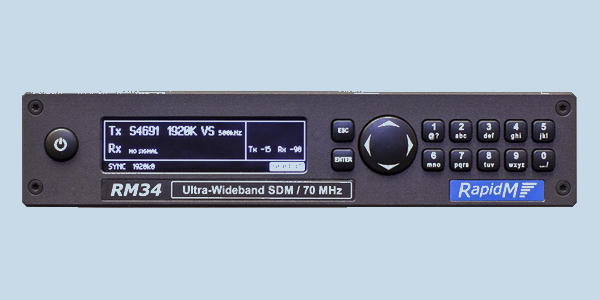
The RM34 Ultra-Wideband V/UHF Software Defined Modem (SDM) is a standalone hardware platform engineered for high-capacity data communication over V/UHF radio channels. It delivers long-distance, line-of-sight (LOS) data communications designed to support strategic and maritime operations requiring internet protocol (IP)-based data exchange.
Technical Summary
- Baseband/IF: 70 MHz intermediate-frequency (IF) digitiser
- Bandwidth: Supports 500 kHz V/UHF radio channels
- Data Interfaces: Serial, Ethernet
- Radio Interfaces: 70 MHz RF, Analog Baseband, VITA-49.2
- Timing: Accurate time updates via GPS or NTP
- Reliability: MTBF > 40,000 hours
Operational Use Cases
- Secure tactical communications
- Maritime command and control (C2) operations
- High-capacity IP-based data exchange
- Strategic line-of-sight (LOS) data networks
Deployment Environments
The modem is suited for diverse deployment environments, including maritime (surface vessels and submarines), airborne platforms, and fixed land-based installations.
Performance Metrics
- Maximum Data Rate: Up to 1.92 Mbps
- Operating Bandwidth: 500 kHz
- Reliability (MTBF): Greater than 40,000 hours
Setup & Portability
The hardware features a compact ½ 1U form factor, facilitating straightforward integration into standard 19-inch rack mounts for fixed and mobile platform installations.
Compatibility
The RM34 is compatible with the STANAG 4691 V/UHF Time-Division Multiple Access (TDMA) waveform family. It interfaces with external systems via Serial, Ethernet, 70 MHz RF, Analog Baseband, VITA-49.2, and GPS or NTP for timing.
FAQs
- What employment factors affect reliable V/UHF communications? Proper planning requires attention to frequency separation, radio antenna separation, adequate power output, and careful site selection. Always verify system-specific spacing and power requirements prior to deployment.
- What conditions typically degrade V/UHF radio links? Excessive distance, intervening terrain, environmental noise, and RF interference commonly cause poor communication. Defective cabling and improper frequency assignments also reduce link reliability.
- How should communication equipment be maintained in the field? Keep enclosures clean and dry, inspect cable assemblies for damage, and verify proper equipment grounding. Consult the specific technical manuals for complete operating instructions and maintenance schedules.
- Problems we solve: where do we start with incomplete requirements? An incomplete specification can make product selection difficult. Start by sharing the task, operating environment and known constraints with Cyntony so the team can help define what to verify and which options are worth discussing (Our process).
- Outcomes we deliver: what comes from working through the requirements? The practical outcome is a requirements-led set of product options to evaluate with Cyntony. Confirm performance, compatibility and any service scope for your configuration before selection (Our process).
Video Notes
A brief technical overview video demonstrating the 1/2 1U rack-mount integration and rear-panel interface connections (Ethernet, Serial, RF) would assist procurement engineers in verifying physical compatibility.




.svg)


