


Rapid Mobile
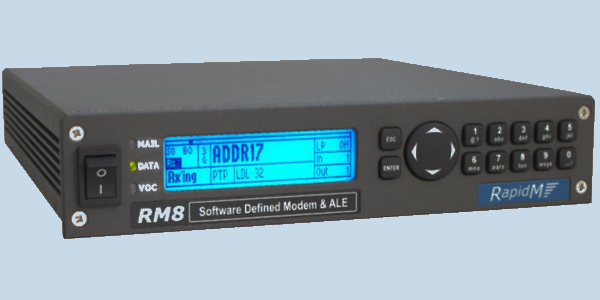
RM8 — Software Defined Modem & ALE Controller
Key specifications
Add this product to your quote to get price and delivery information.
Overview
The RM8 Software Defined Modem & ALE Controller is a standalone unit designed for strategic, maritime, and tactical data communications. It provides a wide range of standards-based waveforms and protocols to enable highly robust, interoperable point-to-point and point-to-multipoint link setup operations.
Technical Summary
- Standards Compliance: MIL-STD 110B, 141C; STANAG 4539 and 4538
- ALE Protocol: Advanced 3G ALE for HF networks with Fast Link Setup (FLSU)
- Data Link Protocols: High-rate Data Link (HDL) and Low-latency Data Link (LDL)
- Supported Frequency Bands: LF, HF, and V/UHF
- Interfaces: Serial and Ethernet remote control
- Timing: Built-in GPS unit for ALE time link protection
Operational Use Cases
- Secure strategic and maritime data communications for naval and governmental users
- Automated fast scanning link setup for Packet, Circuit, and Voice links
- Error-free data delivery under varied HF channel conditions
Deployment Environments
This standalone unit is designed for deployment across Fixed Site, Maritime, and Tactical platforms.
Performance Metrics
- Provides error-free ARQ protocol data delivery
- Supports High Data Rate HF & V/UHF modem operations
Compatibility
Integrates with LF, HF, and V/UHF radio systems and networks. Remote control is supported via standard Serial and Ethernet interfaces.
FAQs
What are the general differences between HF and VHF/UHF data links?
High Frequency (HF) signals enable long-range or beyond-line-of-sight communications by reflecting off the ionosphere. Very High Frequency (VHF) and Ultra High Frequency (UHF) signals provide higher bandwidth but are typically limited to line-of-sight propagation.
What is the primary function of Automatic Link Establishment (ALE)?
ALE protocols automate the process of evaluating channel conditions and selecting optimal frequencies for radio links. This capability maintains reliable network connections across varying atmospheric conditions without requiring manual operator intervention.
How is communications security (COMSEC) maintained on tactical data nets?
Secure transmission typically requires interfacing the radio or modem with a compatible encryption device. Operators must verify interoperability between the selected waveform protocol and the encryption hardware used in the network.
Problems we solve: where do we start with incomplete requirements?
An incomplete specification can make product selection difficult. Start by sharing the task, operating environment and known constraints with Cyntony so the team can help define what to verify and which options are worth discussing (Our process).
Outcomes we deliver: what comes from working through the requirements?
The practical outcome is a requirements-led set of product options to evaluate with Cyntony. Confirm performance, compatibility and any service scope for your configuration before selection (Our process).
