Download our Antenna Buyer’s Guide Today

Download our Antenna Buyer's Guide to discover the essential specs and features to look out for while finding the perfect antenna for your project.

Search with confidence and efficiency.

tab-img

AD-18/D-2110 — Wideband Mobile VHF Antenna with Optional GPS

Interested in learning more about this product?

Overview

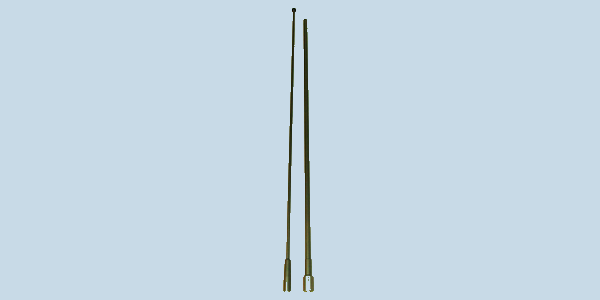
The Trival Antene AD-18/D-2110 is a wideband mobile VHF antenna operating across the 20 to 110 MHz frequency range. It is primarily designed for heavy-duty mobile communications and jamming applications, featuring a rugged, shock-absorbing build and an optional integrated active GPS L1 antenna.

Technical Summary

  • Frequency Range: 20 to 110 MHz
  • GPS Integration: Optional active GPS L1 antenna with built-in LNA
  • VHF Connector Options: N-type or BNC
  • GPS Connector: SMA (when equipped)
  • Materials: Composite radiating elements, stainless steel spring base
  • Finish: Military green (RAL-6014) UV-resistant paint

Operational Use Cases

Primarily intended for use in heavy-duty mobile deployments and tactical jamming applications requiring wideband VHF coverage.

Deployment Environments

Engineered for harsh outdoor and mobile conditions. The base incorporates a stainless steel spring to absorb shocks and vibrations, protecting the antenna from vehicle impacts, while the composite elements and UV-resistant finish ensure durability in exposed environments.

Performance Metrics

Provides continuous wideband coverage across the 20 to 110 MHz VHF spectrum.

Setup & Portability

The antenna is modular, composed of three main parts: an antenna base, a lower radiating element, and an upper radiating element. It features a standard base with four mounting holes arranged on a 4.5-inch circle.

Compatibility

The base complies with NATO mounting standards (four holes on a 4.5-inch circle). Flexible interfacing is provided through available N-type or BNC connector options for the VHF element, and an SMA connector for the GPS L1 option.

FAQs

  • Is this type of antenna used for receive-only or transmitting? While some antennas are receive-only, tactical communications antennas often handle moderate power transmission. Transmit antennas also receive; verify the maximum continuous power and VSWR tolerance required for your specific application.
  • What determines the radiation pattern of an omnidirectional antenna? The radiation pattern describes how energy radiates into three-dimensional space. Typical omnidirectional antennas exhibit gain maximums toward the horizon with reduced gain or nulls directed vertically, depending on the specific design.
  • What platforms are omnidirectional antennas optimized for? Omnidirectional antennas are typically optimized for specific structures, such as vehicles, manpacks, portable tactical setups, or fixed sites. Always confirm the mounting interface and physical dimensions required for your chosen platform.
  • Problems we solve: how do we narrow antenna choices? Balancing operating bands, coverage needs and mounting space can make antenna selection difficult. Share those constraints with Cyntony to compare candidate antennas and identify what needs manufacturer confirmation (Our process).
  • Outcomes we deliver: what comes from working through the requirements? The practical outcome is a requirements-led set of product options to evaluate with Cyntony. Confirm performance, compatibility and any service scope for your configuration before selection (Our process).

Video Notes

A brief demonstration showing the assembly of the three main parts (base, lower element, upper element) and a flexibility test of the shock-absorbing stainless steel spring would be helpful for procurement evaluation.

HOW TO BUY
To obtain price and delivery information about this product, click the button below.