Download our Antenna Buyer’s Guide Today

Download our Antenna Buyer's Guide to discover the essential specs and features to look out for while finding the perfect antenna for your project.

Search with confidence and efficiency.
tab-img

AD-22/E-50300 — Log-Periodic Dipole Antenna

Interested in learning more about this product?

Overview

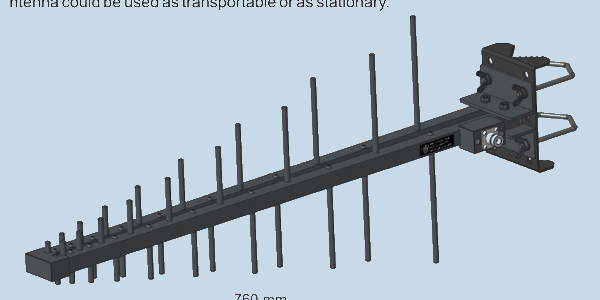
The AD-22/E-50300 is a rugged log-periodic dipole antenna engineered by Trival Antene to operate across the 500 to 3000 MHz frequency range. With a robust power handling capability and resilient aluminum alloy construction, it serves as a highly adaptable asset for both transportable tactical missions and stationary fixed-site installations.

Technical Summary

  • Frequency Range: 500 to 3000 MHz (UHF, S Band)
  • Antenna Type: Directional Log-Periodic Dipole
  • Power Handling: 250 W CW
  • Typical Gain: 7.5 dBi
  • Polarization: Horizontal and Vertical

Operational Use Cases

This broadband directional antenna is designed to support demanding RF operations, including:

  • Radio monitoring
  • Signal jamming
  • EMC testing
  • Broadcast applications

Deployment Environments

Built for durability in harsh conditions, the antenna features an IP65 rating and operates reliably in extreme temperatures ranging from -55 to +80 °C. The boom and 17 dipole elements are manufactured from aluminum alloy, protected by an irridite finish, and coated with a two-component UV-resistant polyurethane paint.

Performance Metrics

Frequency Range500 - 3000 MHz
Continuous Power (CW)250 W
Typical Gain7.5 dBi

Setup & Portability

The integrated support mechanism accommodates mast mounting on diameters between 26 mm (1 inch) and 60 mm (2 inches). This highly adaptable mounting system allows rapid deployment as either a transportable tactical asset or a permanent fixed-site antenna.

FAQs

  • What are the operational advantages of a directional log-periodic dipole antenna? Directional antennas deliver focused power in a favored direction compared to omnidirectional alternatives. This concentration enhances effective radiated power toward intended targets while significantly diminishing radiated signature in opposing directions.
  • How does antenna polarization impact signal transmission? Polarization describes the orientation of the electromagnetic wave's electric field as it travels through space. Matching the polarization state between transmitting and receiving antennas provides the optimal transmission path and minimizes signal loss.
  • How should mast height be evaluated for optimal antenna deployment? Raising an antenna on a telescoping mast helps overcome physical obstacles and establish a clear line of sight. Verify the deployment environment to determine the required mast height for sufficient standoff and propagation advantage.
  • Problems we solve: how do we narrow antenna choices? Balancing operating bands, coverage needs and mounting space can make antenna selection difficult. Share those constraints with Cyntony to compare candidate antennas and identify what needs manufacturer confirmation (Our process).
  • Outcomes we deliver: what comes from working through the requirements? The practical outcome is a requirements-led set of product options to evaluate with Cyntony. Confirm performance, compatibility and any service scope for your configuration before selection (Our process).

Video Notes

A product demonstration video illustrating the attachment of the antenna to a standard 60 mm mast and highlighting the rugged UV-resistant finish would be beneficial for procurement teams.

HOW TO BUY
To obtain price and delivery information about this product, click the button below.