Download our Antenna Buyer’s Guide Today

Download our Antenna Buyer's Guide to discover the essential specs and features to look out for while finding the perfect antenna for your project.

Search with confidence and efficiency.

tab-img

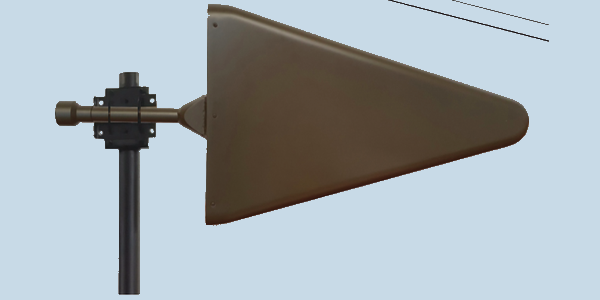
AD-22/G-HP — Rev. A High Power Log-Periodic Dipole Antenna

Interested in learning more about this product?

Overview

The AD-22/G-HP Rev. A is a high-power log-periodic dipole antenna covering a continuous frequency range from 400 to 6000 MHz. Designed by Trival Antene, it is built to support broadcast, EMC applications, radio monitoring, and jamming operations.

Technical Summary

  • Frequency Range: 400 to 6000 MHz (UHF, L, S, and C bands)
  • Power Handling: Up to 2750 W CW
  • Typical Gain: 8 dBi
  • Polarization: Horizontal / Vertical
  • Construction: Silver-plated brass dipoles and boom enclosed in a fiberglass housing

Operational Use Cases

  • Radio monitoring and signal intelligence
  • High-power signal jamming
  • Electromagnetic compatibility (EMC) testing
  • Broadcast operations

Deployment Environments

Designed for versatile deployment, this antenna supports both tactical transportable setups and permanent fixed-site stationary installations.

Performance Metrics

  • Operating Frequencies: 400 MHz - 6000 MHz
  • Maximum Power: 2750 W CW at 400 MHz (>1kW class)
  • Gain: Typically 8 dBi (falls within the 4 to 16 dB range)

Setup & Portability

The boom includes an integrated antenna support on the end, allowing for mounting on standard masts with an outer diameter between 1 inch (26 mm) and 2 inches (60 mm).

FAQs

  • How does a log-periodic dipole antenna (LPDA) direct signal coverage? An LPDA concentrates radiated power in a forward direction while significantly diminishing power to the sides and rear. Verify the specific azimuthal beamwidth and front-to-back ratio on the manufacturer's datasheet.
  • What does linear horizontal or vertical polarization mean for signal reception? Linear polarization indicates that the electromagnetic wave's electric field varies in a single, straight plane. Orienting the transmitting and receiving antennas to the same polarization provides the most efficient transmission path.
  • What is required to mount this directional antenna? The antenna features a rear support bracket designed to attach to masts with an outer diameter between 26 mm and 60 mm. Verify that the selected mast safely supports the physical load.
  • Problems we solve: how do we narrow antenna choices? Balancing operating bands, coverage needs and mounting space can make antenna selection difficult. Share those constraints with Cyntony to compare candidate antennas and identify what needs manufacturer confirmation (Our process).
  • Outcomes we deliver: what comes from working through the requirements? The practical outcome is a requirements-led set of product options to evaluate with Cyntony. Confirm performance, compatibility and any service scope for your configuration before selection (Our process).

Video Notes

A video demonstrating the mast-mounting process using the 1" to 2" support bracket would be helpful for setup guidance. An animated visualization of the LPDA's directional radiation pattern across its 400-6000 MHz range would effectively highlight its performance.

HOW TO BUY
To obtain price and delivery information about this product, click the button below.