Download our Antenna Buyer’s Guide Today

Download our Antenna Buyer's Guide to discover the essential specs and features to look out for while finding the perfect antenna for your project.

Search with confidence and efficiency.
tab-img

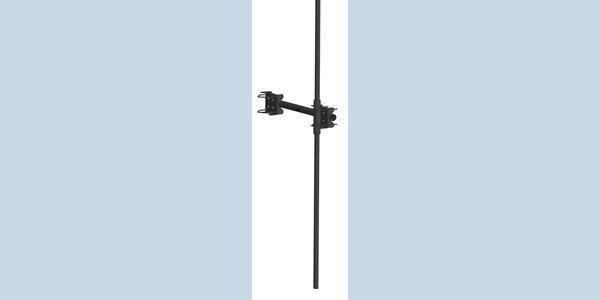
AD-39/2512-AW — Stationary VHF/UHF Dipole Antenna

Interested in learning more about this product?

Overview

The AD-39/2512-AW is a robust VHF/UHF dipole antenna engineered for stationary applications across the 20 to 620 MHz frequency range. Built with a lightweight aluminum and fiberglass construction, it offers wideband performance and exceptional structural durability in harsh environmental conditions.

Technical Summary

  • Frequency Range: 20 to 620 MHz
  • Antenna Type: Dipole with central matching unit and balun transformer
  • Polarization: Configurable for vertical or horizontal
  • Construction: Aluminum matching unit housing with fiberglass-enclosed dipoles
  • Finish: Black painted fiberglass; black passivated or cataphoresis-protected metal components

Operational Use Cases

Designed for stationary deployments requiring reliable VHF and UHF coverage. It is well-suited for fixed-site communications infrastructure where wideband frequency support and long-term structural resilience are necessary.

Deployment Environments

  • Wind Resistance: Withstands heavy winds up to 200 km/h
  • Ice Loading: Survives heavy ice loads up to 20 mm
  • Durability: Ruggedized for harsh weather conditions

Performance Metrics

  • Operating Frequency: 20 to 620 MHz
  • Supported Polarizations: Vertical or horizontal

Setup & Portability

The antenna includes mounting accessories designed for installation on square or round structural tubes. The hardware accommodates tube diameters up to 120 mm. The assembly can be oriented during installation to support either vertical or horizontal polarization.

FAQs

  • When is a dipole antenna typically selected? Selection depends on the platform, co-siting requirements, and the ability to form a suitable counterpoise. Dipole antennas are commonly used for fixed-site and portable applications, whereas monopoles are often chosen for handheld radios.
  • What does antenna polarization indicate? Polarization describes the orientation of the radiated electric field, not the angular coverage shape. Match the transmitting and receiving antenna polarizations to optimize signal coupling, and consult the manufacturer's measured pattern cuts to verify angular coverage.
  • What must be verified for transmitter compatibility? Confirm the antenna can handle the transmitter's maximum continuous power output across the expected frequency range. Also, verify that the antenna impedance match keeps reflected power below the transmitter's tolerated VSWR limits.
  • Problems we solve: how do we narrow antenna choices? Balancing operating bands, coverage needs and mounting space can make antenna selection difficult. Share those constraints with Cyntony to compare candidate antennas and identify what needs manufacturer confirmation (Our process).
  • Outcomes we deliver: what comes from working through the requirements? The practical outcome is a requirements-led set of product options to evaluate with Cyntony. Confirm performance, compatibility and any service scope for your configuration before selection (Our process).

Video Notes

A video demonstrating the installation process on a 120 mm tube and showcasing the aluminum and fiberglass construction would be beneficial. Include visual confirmation of the hardware configurations for both horizontal and vertical polarization setups.

HOW TO BUY
To obtain price and delivery information about this product, click the button below.