Download our Antenna Buyer’s Guide Today

Download our Antenna Buyer's Guide to discover the essential specs and features to look out for while finding the perfect antenna for your project.

Search with confidence and efficiency.

tab-img

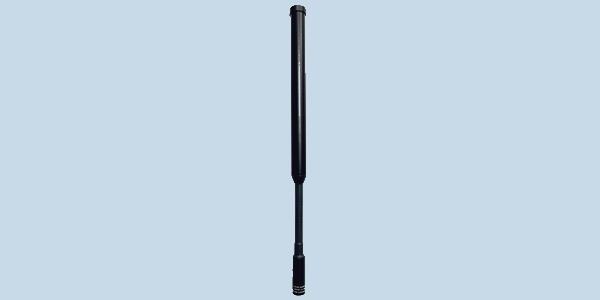
AD-64/F2 — Ultra Wideband Manpack Antenna

Interested in learning more about this product?

Overview

The AD-64/F2 is an ultra wideband manpack antenna designed for integration with modern broadband software-defined radios (SDRs), jammers, and scanners. Manufactured by Trival Antene, it utilizes a center-fed sleeve dipole architecture, allowing efficient operation independent of a ground plane.

Technical Summary

  • Frequency Range: 400 - 2800 MHz
  • Gain: -4 to +2 dBi
  • VSWR: < 3
  • Impedance: 50 ohms
  • Maximum Power: 50 W CW
  • Polarization: Linear Vertical
  • Connector: TNC male

Operational Use Cases

This antenna is engineered for Jamming, Monitoring, and Tactical Communication applications. Its ultra wideband coverage supports multi-mission operations utilizing wideband SDRs and specialized RF scanning or jamming equipment.

Deployment Environments

Designed for deployment in harsh military environments, the antenna complies with MIL-STD-810G standards for extreme storage and operating temperatures. The radiating element is protected by a durable, ruggedized fiberglass radome.

Performance Metrics

  • Frequency Coverage: Continuous UHF to S-band capability (400 - 2800 MHz)
  • Gain Profile: -4 to +2 dBi across the specified frequency range
  • Electrical Dimensions: Functions without requiring an external ground plane

Setup & Portability

Optimized for manpack platforms, the AD-64/F2 features a flexible gooseneck that allows the antenna to be bent and secured in almost any position for tactical versatility. It is lightweight at just 0.44 kg and has an overall height of 500 mm.

Compatibility

Compatible with manpack RF systems, broadband SDRs, and jammers that provide a 50-ohm TNC female RF interface and operate within the 50 W CW continuous power limit.

FAQs

  • Does a sleeve dipole antenna require a ground plane? No. A center-fed dipole design operates independently of a ground plane, unlike monopole antennas that rely on a conductive surface to complete their electromagnetic structure.
  • How should maximum power handling be evaluated for tactical antennas? Compare the transmitter's maximum continuous output power against the antenna's continuous wave (CW) rating. Confirming this compatibility helps maintain reflected power within the transmitter's tolerated limits.
  • How should a vertically polarized manpack antenna be oriented? For optimal polarization matching with a network, the antenna element should remain physically vertical. This model includes a flexible gooseneck, allowing operators to adjust the orientation independently of the radio.
  • Problems we solve: how do we narrow antenna choices? Balancing operating bands, coverage needs and mounting space can make antenna selection difficult. Share those constraints with Cyntony to compare candidate antennas and identify what needs manufacturer confirmation (Our process).
  • Outcomes we deliver: what changed for Espy's compact monitoring system? Cyntony helped Espy source antennas that fitted a compact transit case and coordinated later sourcing revisions for removable mounting. This documented result concerns Espy's system; it does not establish this product's dimensions, mounting features or performance (Espy case study).

Video Notes

A short video demonstrating the flexibility of the gooseneck section and the attachment to a standard manpack SDR would enhance this page.

HOW TO BUY
To obtain price and delivery information about this product, click the button below.