Download our Antenna Buyer’s Guide Today

Download our Antenna Buyer's Guide to discover the essential specs and features to look out for while finding the perfect antenna for your project.

Search with confidence and efficiency.

tab-img

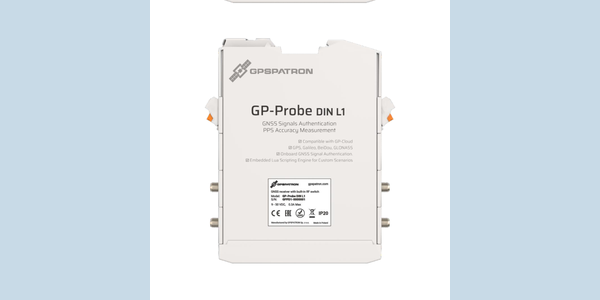
GP-Probe DIN L1 — GNSS Interference and Synchronization Quality Probe

Interested in learning more about this product?

Overview

The GP-Probe DIN L1 is a cost-effective, single-channel GNSS probe designed for telecom and critical infrastructure. It continuously monitors GNSS interference and synchronization quality, actively preventing counterfeit signals from reaching time servers or receivers.

Technical Summary

  • Architecture: Single-channel inline GNSS probe
  • Spectrum Monitoring: 65 MHz basic RF spectrum monitoring feature
  • Protection: Integrated GNSS RF switch with an embedded jammer/RF blocker
  • Timing: Built-in PPS Phase Measurement Unit
  • Customization: Embedded LUA script engine for developing custom response scenarios

Operational Use Cases

  • GNSS interference detection, classification, and logging
  • PPS accuracy monitoring and GNSS signal quality analysis
  • Counterfeit signal isolation for telecom and datacenter time servers

Deployment Environments

Designed for rugged industrial and datacenter environments. It features a DIN rail housing suitable for standard industrial control cabinets or equipment racks.

Performance Metrics

  • RF Analysis Bandwidth: 65 MHz basic RF spectrum monitoring
  • Channel Count: One-channel probe design

Setup & Portability

The device is easily installed inline between a standard GNSS antenna and a downstream receiver or time server. The DIN rail housing allows for rapid integration into existing industrial infrastructure.

Compatibility

Interfaces physically between GNSS antennas and standard receivers or time servers. It supports centralized monitoring, self-diagnostics, and secure firmware updates via GP-Cloud, while also providing an onboard signal processing option for standalone operation without a cloud connection.

FAQs

  • What are the operational impacts of GNSS interference in telecommunications? Many telecom networks and power grids rely on GNSS-based timing for synchronization. Disruptions from spoofing or jamming can result in network instability, degraded service quality, and potential infrastructure failures.
  • How does an inline probe protect systems from spoofing attacks? Installed directly between a GNSS antenna and a receiver, an inline probe continuously monitors signal integrity. Upon detecting an anomaly, it immediately disables GNSS and PPS outputs to block counterfeit signals.
  • Does anomaly detection require a continuous cloud connection? No. An onboard signal processing option enables standalone anomaly detection and mitigation without a continuous cloud connection, though centralized platforms can aggregate diagnostic data when networked.
  • Problems we solve: how do we scope a GNSS monitoring requirement? Interference concerns alone do not define a GNSS monitoring requirement. Share your site or platform, operating conditions and the information operators need so Cyntony can help compare candidate solutions (Our process).
  • Outcomes we deliver: what comes from working through the requirements? The practical outcome is a requirements-led set of product options to evaluate with Cyntony. Confirm performance, compatibility and any service scope for your configuration before selection (Our process).

Video Notes

A brief demonstration showing the DIN rail mounting and the inline connection between a GNSS antenna and a receiver would be beneficial.

HOW TO BUY
To obtain price and delivery information about this product, click the button below.