Download our Antenna Buyer’s Guide Today

Download our Antenna Buyer's Guide to discover the essential specs and features to look out for while finding the perfect antenna for your project.

Search with confidence and efficiency.

tab-img

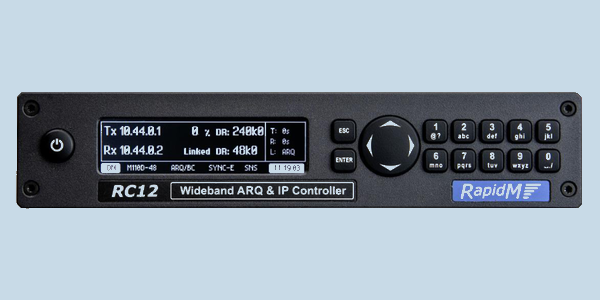
RC12 — Wideband ARQ & IP Controller

Interested in learning more about this product?

Overview

The RC12 is a software-defined OSI Layer 2 ARQ Server and IP Controller designed for HF radio circuits. It provides highly reliable, standards-conformant protocol and embedded voice functions to enable seamless end-to-end interoperability between strategic and tactical data and voice radio systems for NATO and Allied Forces.

Technical Summary

  • ARQ Protocol Stack: STANAG 5066 Edition 4 (up to 240,000 bps) with automatic Data Rate Change (DRC)
  • ELOS Controller: STANAG 4691 Appendix A MARLIN Controller
  • Voice Coder: STANAG 4591 Enhanced MELPe (1200 and 2400 bps)
  • Modem Support: Dedicated Tx and Rx modems for split-site operation
  • Enclosure: Compact 19-inch rack-mountable unit

Operational Use Cases

  • Strategic and tactical secure data and voice communication nets
  • Task force ship-to-ship command and control operations
  • HF Beyond-Line-Of-Sight (BLOS) data communication
  • HF Extended Line-of-Sight (ELOS) operations

Deployment Environments

The unit is suited for airborne, fixed site, and maritime platforms. It is housed in a 19-inch rack-mountable form factor and complies with MIL-STD-810H and MIL-STD-461G standards for demanding operational environments.

Performance Metrics

  • Data Rates: Supports bandwidths up to 240,000 bps
  • Vocoder Rates: 1200 and 2400 bps
  • Standards Compliance: MIL-STD-810H, MIL-STD-461G, STANAG 5066 Ed. 4, STANAG 4691, STANAG 4591

Setup & Portability

The controller integrates into standard 19-inch racks. Its embedded software functions can be ordered separately and activated via software keys, providing flexibility for specific deployment needs and facilitating split-site operations.

Compatibility

The system supports multi-frequency ALE/ALM and provides OSI Layer 2 interoperability across HF, VHF, and UHF bands. It interfaces with dedicated transmit and receive modems for adaptable radio circuit configurations.

FAQs

  • What environmental and operational factors degrade tactical radio communications? Common causes of degraded communication include excessive distance, terrain obstacles, electromagnetic interference, and improper frequency assignment. Siting and frequency selection are critical for establishing reliable data nets.
  • Why is packet switching important for tactical radio networks? Packet switching enables multiple data types to share limited radio channels efficiently. Utilizing IP controllers manages these packets to maintain stable communication across HF, VHF, and UHF frequency regimes.
  • What must be verified before connecting a terminal or modem to a radio system? Ensure the operating frequencies and maximum continuous power levels are compatible. Operators must also verify that the transmitter can tolerate the anticipated maximum VSWR to prevent amplifier damage.
  • Problems we solve: where do we start with incomplete requirements? An incomplete specification can make product selection difficult. Start by sharing the task, operating environment and known constraints with Cyntony so the team can help define what to verify and which options are worth discussing (Our process).
  • Outcomes we deliver: what comes from working through the requirements? The practical outcome is a requirements-led set of product options to evaluate with Cyntony. Confirm performance, compatibility and any service scope for your configuration before selection (Our process).

Video Notes

A brief overview demonstrating the software key activation process and a diagram explaining the split-site Tx/Rx modem configuration would be highly beneficial for system integrators.

HOW TO BUY
To obtain price and delivery information about this product, click the button below.