Download our Antenna Buyer’s Guide Today

Download our Antenna Buyer's Guide to discover the essential specs and features to look out for while finding the perfect antenna for your project.

Search with confidence and efficiency.

tab-img

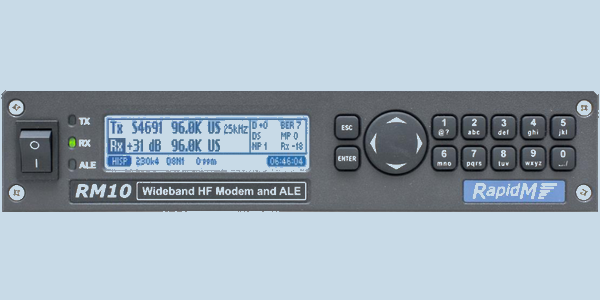
RM10 — V/UHF Data Modem

Interested in learning more about this product?

Overview

The RM10 Wideband Software Defined Modem (SDM) is a standalone hardware platform engineered for strategic and maritime WBHF Beyond Line-of-Sight (BLOS) and V/UHF Line-of-Sight (LOS) communications. It is optimized for routing IP traffic, video streaming, and high-capacity data across tactical networks.

Technical Summary

  • Device Type: Software Defined Modem (SDM)
  • Frequency Bands: WBHF, VHF, and UHF
  • Standard Compliance: NATO STANAG 4691 Annex B (UHF)
  • Timing: Built-in GPS receiver for time referencing and linking protection

Operational Use Cases

Designed for secure tactical data links, this modem enables high-capacity communications for command and control operations. When integrated with a compatible node controller, it supports Extended Line-Of-Sight (ELOS) networking via a 2- or 3-hop MANET.

Deployment Environments

Suitable for diverse operational domains, the modem supports integration into maritime vessels, ground vehicles, fixed sites, and tactical field deployments.

Performance Metrics

  • UHF Data Rates: 12.8 kbps to 96 kbps (25 kHz bandwidth)
  • VHF Data Rates: Up to 128 kbps (proprietary waveform)
  • Audio Interface: 20 kHz bandwidth for legacy connections

Compatibility

The modem seamlessly integrates with the RC10 MARLIN Node Controller for advanced ELOS networking. It maintains backward compatibility with legacy tactical radios via a standard 20 kHz audio interface.

FAQs

  • What data rates does a STANAG 4691 Annex B modem provide? The RM10 modem delivers user data rates between 12.8 kbps and 96 kbps within a 25 kHz UHF channel bandwidth.
  • How do wideband modems interface with legacy analog radios? Modems connect to older transceivers using standard analog audio inputs. Verify that the legacy radio supports the required audio bandwidth, such as 20 kHz, to pass the waveform effectively.
  • What factors ensure reliable V/UHF communications in tactical deployments? Proper equipment grounding, adequate antenna separation, and verified cable assemblies are essential. Always maximize frequency separation between colocated radios to prevent receiver desensitization and interference.
  • Problems we solve: where do we start with incomplete requirements? An incomplete specification can make product selection difficult. Start by sharing the task, operating environment and known constraints with Cyntony so the team can help define what to verify and which options are worth discussing (Our process).
  • Outcomes we deliver: what comes from working through the requirements? The practical outcome is a requirements-led set of product options to evaluate with Cyntony. Confirm performance, compatibility and any service scope for your configuration before selection (Our process).

HOW TO BUY
To obtain price and delivery information about this product, click the button below.