Download our Antenna Buyer’s Guide Today

Download our Antenna Buyer's Guide to discover the essential specs and features to look out for while finding the perfect antenna for your project.

Search with confidence and efficiency.

tab-img

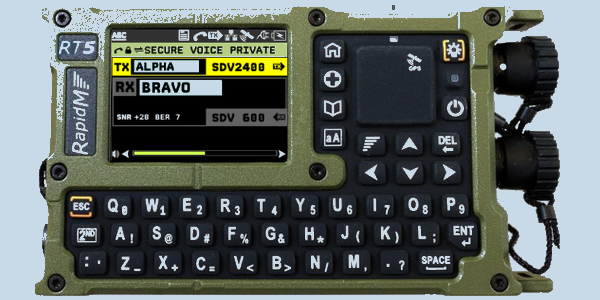
RT5 — Tactical Voice & Data Terminal

Interested in learning more about this product?

Overview

The RT5 is an ultra-rugged Tactical Voice and Data Terminal designed to interface with any HF or V/UHF radio. It provides secure digital voice, position reporting, and messaging capabilities for critical operations in extreme environments.

Technical Summary

  • Modem: STANAG 4538 3G with ALE and ARQ
  • Security: AES-256 over-the-air encryption
  • Vocoder: Dynamic rate from 300 to 2400 bps
  • Display: 2.4" color OLED
  • Interface: Integrated QWERTY keyboard
  • Navigation: Built-in GPS module

Operational Use Cases

  • Secure digital voice communications over adverse RF channels
  • Automated position broadcasts for friendly force tracking
  • On-device text messaging and tactical data transfer
  • Email transmission when paired with compatible PC software

Deployment Environments

This terminal is purposed for Special Operations Forces (SOF), dismounted troops, vehicle platforms, and base stations. The enclosure meets MIL-STD-810F for immersion, humidity, shock, vibration, and dust, as well as MIL-STD-461 for EMC/EMI compliance. It operates in temperatures from -40°C to +60°C.

Performance Metrics

  • Vocoder Rate: 300 to 2400 bps
  • Operating Temperature: -40°C to +60°C
  • External Power Input: 5-36 V DC

Setup & Portability

The device can be powered by standard AA batteries for dismounted, portable operations. For vehicle and fixed-site installations, it accepts an external 5-36 V DC power source and includes MIL-STD-1275B vehicle power protection.

Compatibility

  • Compatible with any HF or V/UHF radio system
  • Interoperable with RapidM RT1, RT3, and RT7 terminals
  • Expandable with RapidM PC software for advanced messaging

FAQs

  • What are the propagation differences between HF and VHF/UHF communications? VHF and UHF frequencies typically operate within line-of-sight ranges and may experience multipath fading. High Frequency (HF) signals utilize ground wave or skywave propagation, providing extended communication ranges depending on atmospheric conditions.
  • What is the function of Automatic Link Establishment (ALE) in tactical modems? ALE automates the selection of the most suitable frequency for a connection. This mechanism facilitates the link establishment process over variable RF channels without requiring manual operator frequency adjustments.
  • How should external power compatibility be verified for tactical terminals? Compare the terminal's acceptable DC voltage input range against the platform's supply capabilities. Confirm whether the specified equipment provides appropriate voltage spike protection prior to direct connection with vehicle electrical systems.
  • Problems we solve: where do we start with incomplete requirements? An incomplete specification can make product selection difficult. Start by sharing the task, operating environment and known constraints with Cyntony so the team can help define what to verify and which options are worth discussing (Our process).
  • Outcomes we deliver: what comes from working through the requirements? The practical outcome is a requirements-led set of product options to evaluate with Cyntony. Confirm performance, compatibility and any service scope for your configuration before selection (Our process).

Video Notes

Editorial note: Consider a video demonstrating the QWERTY keyboard and OLED display interface during messaging and force tracking workflows.

HOW TO BUY
To obtain price and delivery information about this product, click the button below.