


Trival Antene
AD-11/G — Wideband VHF Dipole Antenna
Less than 1 kW
Key specifications
- Frequency band
- VHF
- Gain
- 0 to 2 dB
- Power handling
- Less than 1 kW
- Polarization
- Vertical
Add this product to your quote to get price and delivery information.
Overview
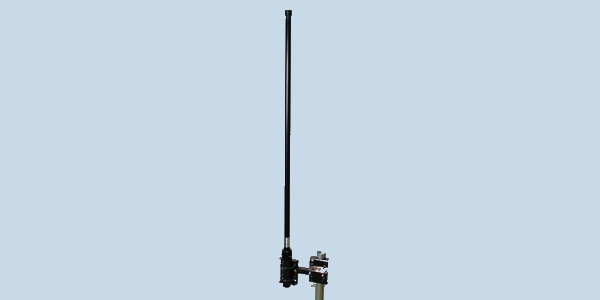
The AD-11/G is a wideband dipole antenna covering the 136 to 176 MHz VHF frequency range. It is intended for stationary and portable applications, featuring a capacitive continuously distributed loading design along the upper radiating element.
Technical Summary
- Frequency Range: 136 - 176 MHz
- Gain: 0 - 1 dBi
- VSWR: < 1.6
- Impedance: 50 ohm
- Maximum Power: 400 W CW
- Polarization: Vertical
Operational Use Cases
Intended for stationary and portable tactical communications requiring wideband VHF omnidirectional coverage.
Deployment Environments
Enclosed in a composite epoxy-glass tube ensuring excellent resistance against atmospheric influences for a long lifespan. All internal metal parts are DC grounded, and the assembly is rated for wind survival up to 150 km/h.
Performance Metrics
- Power Handling: Up to 400 W CW
- Wind Survival: 150 km/h
- Efficiency: VSWR remains below 1.6 across the entire 136-176 MHz band
Setup & Portability
The antenna weighs 1.6 kg and stands 1366 mm tall. It mounts on any metal tube with an inner diameter greater than 30 mm and an outer diameter less than 43 mm (such as a standard 1 1/4-inch tube). Standard mounting consoles and adapter elements (ADK) can also be used.
Compatibility
Compatible with standard 50-ohm RF systems operating within the 136-176 MHz range. Mechanically compatible with standard 1 1/4-inch mast tubes and ADK adapter hardware.
FAQs
When selecting between a dipole and a monopole, what factors should be considered?
The choice depends on the concept of operations and whether the deployment platform can serve as a suitable counterpoise. Portable and fixed-site applications commonly use dipoles, while handheld radios typically use monopoles.
What does vertical polarization specify for an antenna?
Vertical polarization indicates that the antenna's electric field is oriented vertically. It describes the electric-field orientation and polarization matching, but it does not establish angular coverage, beamwidth, or radiation nulls.
What operational limits must be verified for transmitting antennas?
Operators must confirm that the transmitter's maximum continuous power output and tolerable VSWR align with the antenna's ratings. Proper impedance matching keeps reflected power below damaging levels.
Problems we solve: how do we narrow antenna choices?
Balancing operating bands, coverage needs and mounting space can make antenna selection difficult. Share those constraints with Cyntony to compare candidate antennas and identify what needs manufacturer confirmation (Our process).
Outcomes we deliver: what comes from working through the requirements?
The practical outcome is a requirements-led set of product options to evaluate with Cyntony. Confirm performance, compatibility and any service scope for your configuration before selection (Our process).
