


Trival Antene
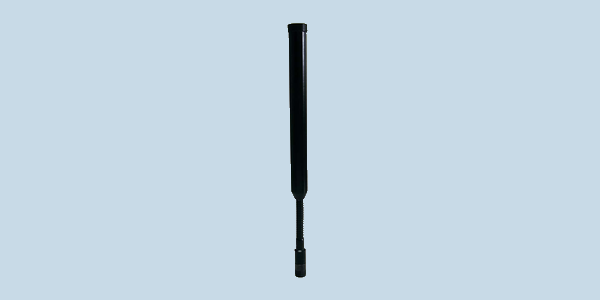
AD-64/C — Ultra Wideband Manpack Antenna
Key specifications
- Frequency band
- UHF
Add this product to your quote to get price and delivery information.
Overview
The AD-64/C is an ultra wideband manpack antenna designed for use with modern broadband software-defined radios (SDR). It features a rugged fiberglass radome and a flexible gooseneck for versatile positioning in harsh military environments.
Technical Summary
- Frequency Range: 1000 - 2500 MHz
- Maximum Power: 20 W CW
- Polarization: Linear Vertical
- Impedance: 50 ohms
- Connector: N male
Operational Use Cases
Intended for use with modern broadband software-defined radios (SDR) operating within the 1000 to 2500 MHz frequency range.
Deployment Environments
Constructed with a rugged fiberglass radome, the antenna is designed for deployment in the harshest military environments as a manpack solution.
Performance Metrics
The antenna supports a maximum power of 20 W CW and covers a continuous frequency range from 1000 to 2500 MHz.
Setup & Portability
Equipped with a flexible gooseneck, the antenna can be bent into almost any position to suit operational needs. Its center-fed sleeve dipole design enables effective operation without requiring a ground plane.
Compatibility
Compatible with systems requiring a 50-ohm impedance and an N male connector interface.
FAQs
Does the sleeve dipole design require a ground plane?
No, this center-fed sleeve dipole operates independently of a ground plane. This allows deployment on platforms that cannot provide a suitable counterpoise.
What parameters must be verified for transmit operations?
Confirm the transmitter's maximum continuous power and frequency match the 20 W CW limit and 1000 to 2500 MHz band. Ensure the transmitter can tolerate the expected system VSWR.
How should the required angular coverage be verified?
Evaluate the principal plane patterns to confirm the radiated energy covers the needed operational area. Verify the specific elevation and azimuth radiation properties independently of the vertical polarization.
Problems we solve: how do we narrow antenna choices?
Balancing operating bands, coverage needs and mounting space can make antenna selection difficult. Share those constraints with Cyntony to compare candidate antennas and identify what needs manufacturer confirmation (Our process).
Outcomes we deliver: what comes from working through the requirements?
The practical outcome is a requirements-led set of product options to evaluate with Cyntony. Confirm performance, compatibility and any service scope for your configuration before selection (Our process).
